6mm vs 8mm Exercise Mat: Which Thickness You Need

You're deciding between two thicknesses on a tab you've had open for a week. Six millimeters or eight. One sounds yoga. The other sounds home gym. The spec sheets don't tell you how the extra two millimeters feel under your knee, your spine, or the wrist of your top hand in a side plank. And every blog post you've read softens the answer into "it depends."
Here's the honest version. There is a right answer for most people, and the right answer depends on three things: your floor, your body, and the longest time you'll spend lying on the mat. The six-versus-eight question is answerable. It needs the three variables, more than the sales copy.

The quick answer, in one paragraph
If your floor is hardwood or tile and you spend more than ten minutes at a time lying on your back, your knees, or your side, go eight. If your floor is already carpeted, if you mostly stand on the mat, or if you want portability, six is enough. Thickness is cushion against hard flooring, and most people underestimate how much they need until the first morning they wake up sore from a thin mat.
What the extra two millimeters do
Two millimeters sounds like nothing on paper. In use, it's the difference between your kneecap resting on cushion and your kneecap pressing through cushion to the floor. The density of the foam matters more than the number, and assuming you're comparing like for like, eight millimeters of non-toxic high-density foam gives roughly thirty percent more compression distance before you bottom out. That's a meaningful cushion for anything that puts a bony point against the floor.
The downside is weight and roll size. Eight millimeters rolls thicker and carries more mass. If you move the mat every day between rooms, six is more convenient. If the mat stays down and lives where you work out, eight is the better feel every single session.
Six millimeters is right when
Six is enough if you're on carpeting, where the carpet pad is doing some of the cushion work for you. Six is enough if your routine is mostly standing: barre, Pilates on your feet, a strength session where you kneel for a minute and move on. Six is enough if the mat is going to roll into a tote and travel with you to a studio, a hotel, or a friend's living room. The thinner mat is more agile, and agility has real value.
Six is fine for taller or lighter frames doing a steady yoga flow on a slightly forgiving floor. The limitation of six is specifically what happens when you load a joint on a hard surface for a sustained period.
Eight millimeters is right when
Eight is the answer if your floor is unforgiving. Concrete, tile, hardwood over slab, laminate over slab. In those rooms, six will cue your body to shift weight off the bony part, and your form drifts. Eight carries you through pigeon, bridge, side plank, dead bug, and a long savasana without the floor telegraphing through.
Eight is also the answer if your routine includes long floor work. Pilates mat series, physical therapy, somatics, restorative yoga, foam rolling. Any routine that keeps you on the floor for twenty to forty-five minutes benefits from the extra cushion, and the benefit compounds over weeks of consistency. The mat you don't dread lying on is the mat you lie on more often.
What people get wrong about thickness
The first mistake is picking by number alone, ignoring density. A ten-millimeter low-density foam mat compresses to nothing under a knee and feels thinner than a six-millimeter high-density mat. The spec that matters is density. High-density foam gives and recovers; low-density foam gives and stays given. If you can press your thumb into the mat and leave a divot, that's a sign to keep looking.
The second mistake is picking by portability when the mat is going to stay out anyway. A lot of people buy six because they imagine themselves carrying it, then never carry it, then wish they'd bought eight. Be honest about where the mat will live.
The third mistake is thinking a thicker mat is less stable. It isn't, as long as the density is right. A dense eight-millimeter mat holds a tree pose as cleanly as a six, because the compression under your standing foot is tiny and even. Softness is a density problem, more than a thickness problem.
Floor-by-floor cheat sheet
Concrete slab: eight, every time. The slab gives nothing, so the mat has to give enough. Hardwood over subfloor: eight is better; six works if you're on carpet in that room most days. Tile: eight. Tile grout is a hard line under a shoulder blade. Laminate: eight if your routine is floor-heavy; six if standing-heavy. Carpet with pad: six is fine for most routines, eight if you're regularly on your knees. Thin area rug on hardwood: eight, treat it like hardwood.
Thickness and size are two separate decisions
A common mistake is picking thickness first and then stretching the size budget. Those are two different problems. Thickness is cushion. Size is extension. A thick, small mat still cuts your longest reach, and a large, thin mat still bruises your shoulder blades on a hard floor. Pick thickness for your floor and your routine, and pick size for your body and your room. An oversized eight-millimeter mat handles both.
Where Swankymat fits in the 6-vs-8 decision
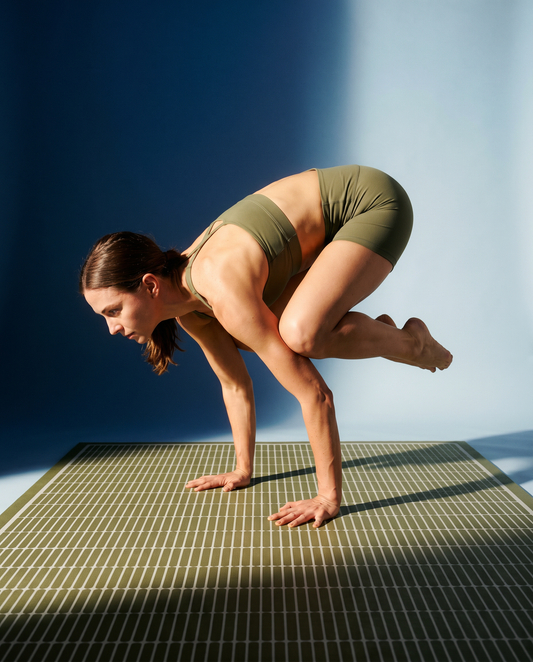
Sloane Forest is our eight-millimeter oversized mat in a deep forest green crosshatch, built for people whose floors are hard and whose routines keep them on the floor for a while. The thickness carries you through pigeon, side plank, and bridge without the floor telegraphing. The forest color grounds a room, especially next to warm wood, and the crosshatch reads like woven linen from across the room.
Under the pattern, Sloane Forest is built on non-toxic high-density foam, printed with Greenguard Gold certified inks on the surface. The oversized footprint means your longest extension lives on cushion. For most people with hard floors and consistent routines, this is the thickness-and-size combination that makes the mat the one they default to.
The Confidence Path to the Right Mat
Picking a mat you'll stand on every day deserves more than guesswork. The Swatch Pack is $15, credited back to your mat, and it's the simplest way to see how a color reads in your room, on your floor, in your light. Hold the fabric-weight prints against the rug, the sofa, the chair you reach for most. The one you keep looking at is the one to order.
If you'd rather we point you toward a shortlist, the Perfect Match Quiz asks a handful of questions about your floor, your room, and the kind of movement you do, then matches you to the two or three mats most likely to feel right. Short, honest, useful.
Start with the Swatch Pack and let the room decide.
The Swankymat Promise
Non-toxic, high-density foam. Supportive cushion built to be stood on, kneeled on, lived on. Odor-free out of the box.
Design-first colorways. Patterns and tones that read like a rug, so the mat belongs in your living room, your bedroom, your office.
Greenguard Gold inks. The print layer is certified for low chemical emissions, so what you see on top isn't off-gassing underneath you.
No Sweat Guarantee, for anyone who orders a swatch pack first. Swap it or send it back for a full refund within 7 days, no sweat.