

How to Choose a Large Exercise Mat for Your Home

Most exercise mats are built to disappear. You roll them out, get through the workout, then roll them back up and shove them in a closet. That works fine for a 24-inch yoga mat. It falls apart the moment you want real space to move, a surface a kid can play on, and something that doesn't look like gym equipment parked in your living room.
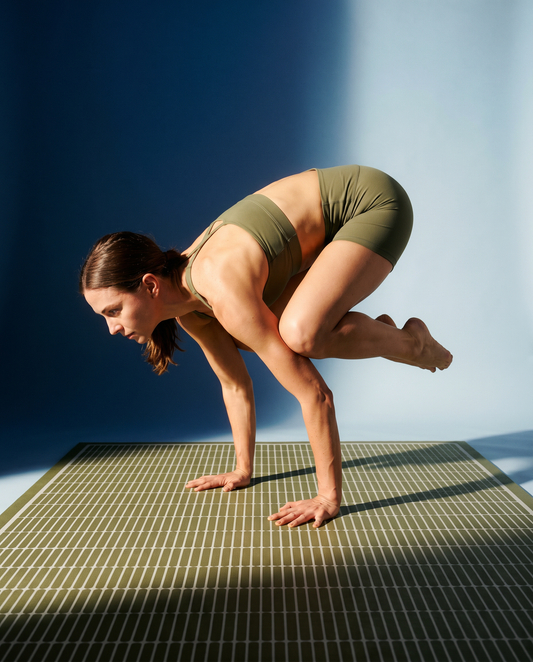
A large exercise mat solves a different problem. It stays down. It gives you room for a full flow, a strength session, or floor work without sliding off the edge. And when it's designed well, it reads as part of the room instead of a piece of equipment you have to hide. This guide covers how to choose one: the right size, what non-toxic actually means, how to keep it clean, and whether you can pay for it with an HSA or FSA.
Why a standard mat stops working at home
A typical exercise or yoga mat runs about 68 to 72 inches long and 24 to 26 inches wide. That footprint is built for one body, standing or seated, moving in a narrow lane. The second you add a wide-leg lunge, a side plank, a child next to you, or a partner, you run out of mat. For a deeper look at the trade-offs, see what to look for in a home workout mat.
The other issue is friction. Roll-up mats curl at the corners, slide on hard floors, and need to be unrolled and re-rolled every session. None of that sounds like much until it's the reason the mat lives in a closet and the workout doesn't happen. A surface that's already on the floor, flat and ready, removes the setup step entirely. That's the real argument for going large: not just more room, but a mat that stays out and gets used.
What size large exercise mat do you actually need?
Sizing a large mat is less about your height and more about how you move and who shares the space. Two questions decide it: what you do on it, and how much floor you have.
Size by activity
- Yoga, Pilates, and mobility: You need length for a full body plus room to extend arms and legs sideways. A mat in the 5-by-7-foot range gives a single person space for a complete flow without clipping the edge.
- Strength, HIIT, and floor work: Dynamic movement eats space. Burpees, lateral work, and weights call for more width and a forgiving surface underfoot. This is where a 6-by-9-foot mat earns its size.
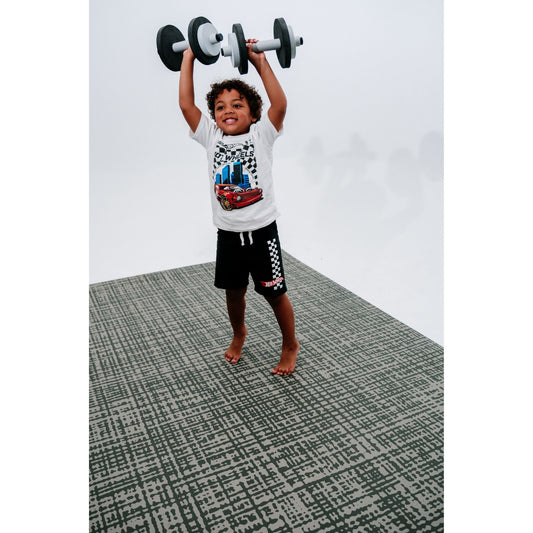
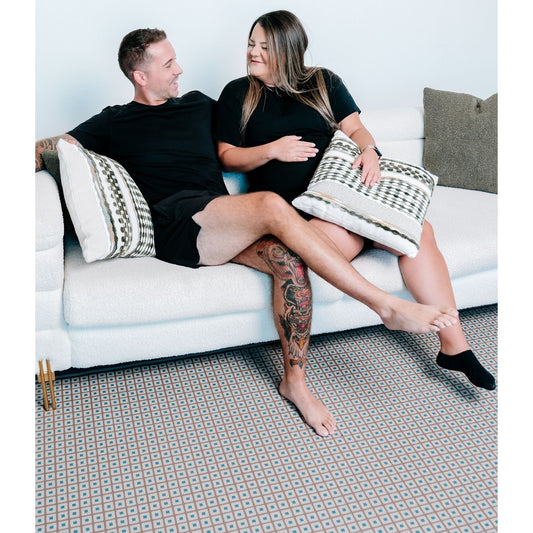
- Two people or family use: Partner workouts, a parent moving while a child plays nearby, or a stretch session next to a toddler all need a shared footprint. Bigger is the point here, not the exception.
Size by room
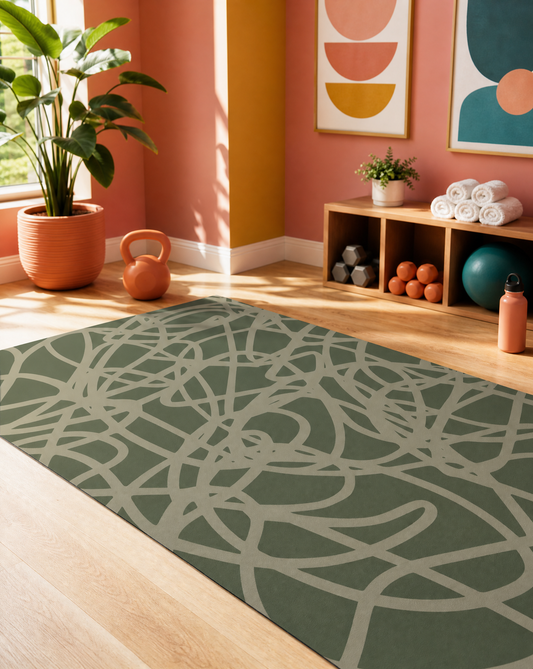
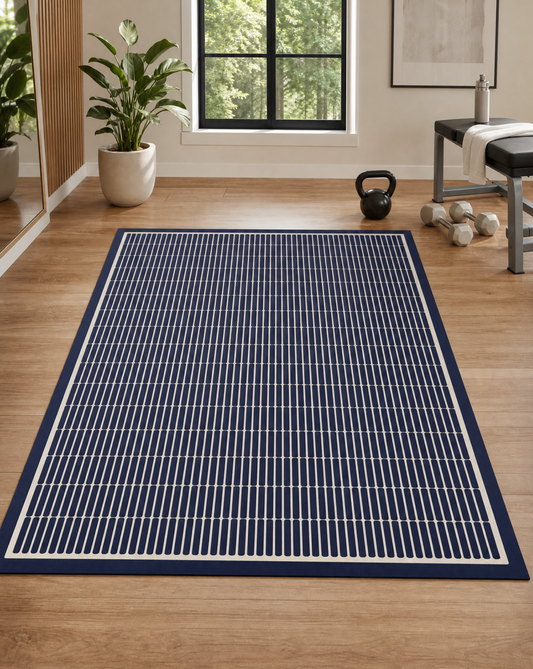
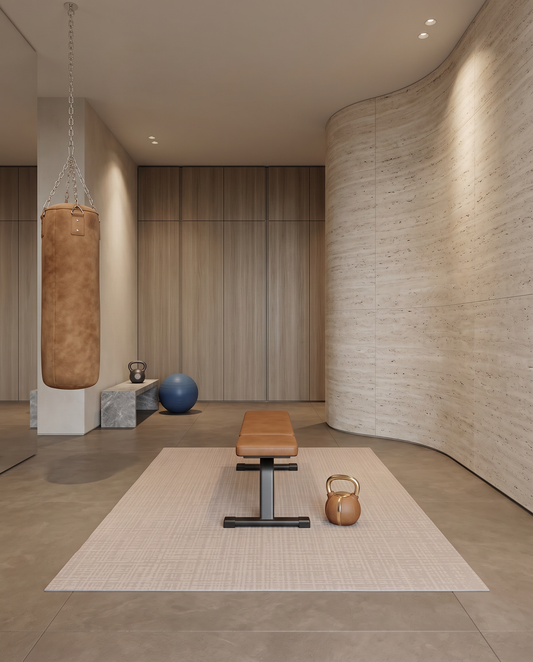
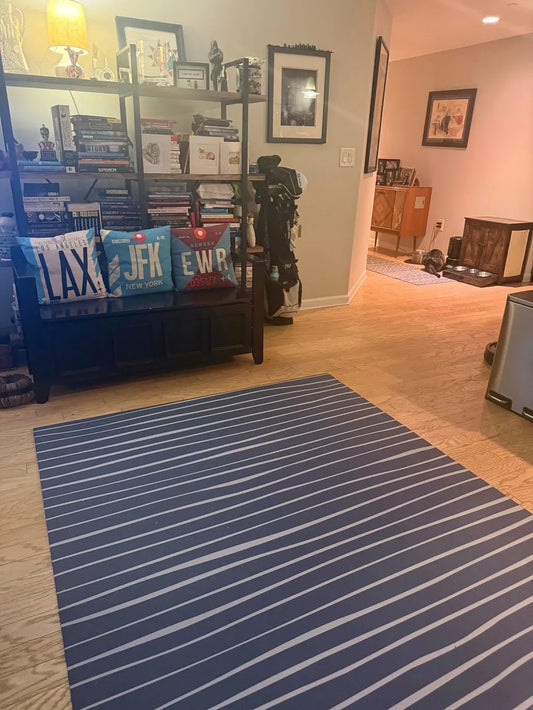
Measure the open floor where the mat will live before you choose. Leave clearance on at least one long side so you can step on and off, and so the mat reads as intentional rather than wall-to-wall. A large mat behaves like an area rug: it anchors the seating zone, defines the space, and gives the room a center. A 5-by-7 sits comfortably in most bedrooms and apartment living rooms, and works well as a large yoga mat for small spaces. A 6-by-9 anchors a larger living room or a dedicated movement corner.
If your practice is studio-style and you'd rather stow the mat between sessions, a traditional studio-shape mat that rolls up and stows away is the better call. It keeps the long, narrow proportions of a classic mat while still giving you a quality surface.
| Your main use | Who's on it | Size to look at |
|---|---|---|
| Yoga, Pilates, mobility | One person | 5×7 ft |
| Strength, HIIT, floor work | One to two people | 6×9 ft |
| Workouts + kids' play + everyday living | Family | 6×9 ft |
| Studio-style practice, stowed between uses | One person | Studio shape, rolls up |
Materials and safety: what "non-toxic" really means
This is the part most buying guides skip in a single line, and it's the part that matters most if a mat is going to live on your floor for years with kids or pets around it. "Non-toxic" is only useful if you know what non-toxic really means.
Start with the surface you'll actually be on: look for a non-toxic, high-density foam that gives a genuinely supportive cushion. Density is what separates a mat that protects your joints from one that bottoms out under your knees and elbows. Around 6mm of high-density cushion is a good benchmark for comfort that still keeps you stable.
Then look at what's not in it. Quality non-toxic mats are free from phthalates, BPA, and added flame retardants, and they use tested, certified materials rather than vague "eco" claims. Certifications are the proof: Greenguard Gold, for example, sets strict limits on chemical emissions, so a mat made with Greenguard Gold certified inks is held to a real standard rather than a marketing one. A low-odor or no-odor mat is another good sign, since strong off-gassing smell out of the box usually means there's something there you'd rather not breathe.
Finally, the surface itself. A waterproof, single-piece top wipes clean and doesn't trap anything in seams the way foam puzzle tiles do. That construction is what makes a mat safe to use as a play surface and easy to keep that way.
Choosing a mat that looks good in your home
A large mat takes up real visual space, so the design decision is as important as the spec sheet. The goal is a mat that anchors the room rather than fighting it.
- Color: Warm neutrals such as limestone, sand, olive, and navy sit quietly under furniture and read as decor. If you want a statement, a considered pattern works better than a busy one that competes with everything else in the room.
- Finish: A matte, textured surface looks more like a rug and less like equipment, and it gives you grip at the same time.
- Proportion: Match the mat to the zone it anchors. Too small and it floats; sized right, it grounds the seating area or the corner you move in.
- Edges: Clean, flat edges keep the look intentional and stay out of the way underfoot.
The test is simple: if you'd be happy to leave it out when guests come over, it's the right mat. A surface you want to hide is one you'll stop using.
How to clean and care for a large floor mat
A mat that lives on your floor needs to be genuinely easy to clean, or it won't stay nice for long. The advantage of a waterproof, single-piece surface is that cleaning is quick: a damp cloth and a little mild soap handles spills, sweat, and everyday mess. Wipe it down, let it dry, and it's ready.
This is where large mats pull ahead of the alternatives. Foam puzzle tiles trap dust and crumbs in every seam, and washable rugs have to be hauled to a machine. A one-piece wipe-clean mat skips both problems. A quick wipe after a sweaty session and the occasional pass with a vacuum keeps it looking new, and a flat, low-profile mat is friendly to a robot vacuum running over it.
Can you use an HSA or FSA to buy an exercise mat?
This is the question almost no buying guide answers, and it can change the math on a quality mat. In many cases an exercise mat can qualify as an HSA- or FSA-eligible expense, often with a Letter of Medical Necessity from your provider when it's tied to physical therapy, recovery, or a medical condition. Eligibility depends on your plan and administrator, so it's worth a quick check before you buy.
When it applies, paying with pre-tax dollars saves you an average of 30%. On a premium mat that's a meaningful difference, and it's the kind of detail that's easy to miss. If you want the specifics on how it works and what qualifies, our HSA/FSA eligible exercise mat page walks through it.
Large mat vs. yoga mat vs. foam tiles vs. washable rug
Most people choosing a large exercise mat are really deciding between four options. Here's how they compare across what matters.
| Large exercise mat | Standard yoga mat | Foam puzzle tiles | Washable rug | |
|---|---|---|---|---|
| Room to move | Excellent | Limited | Good | Good |
| Cushion / support | High-density, supportive | Thin to moderate | Soft, can bottom out | Minimal |
| Looks at home | Designed to | No | "Daycare" look | Yes |
| Cleaning | Wipe clean | Wipe clean | Seams trap dirt | Machine wash |
| Stays put | Yes | Rolls / slides | Shifts apart | Yes |
| One surface, many uses | Yes | No | Play mostly | No |
Where Swankymat fits
Swankymat was built for exactly this gap. It's a large, single-piece mat with a non-toxic, high-density foam core, a 6mm supportive cushion under a grippy, waterproof, wipe-clean top. It's made to stay on the floor and look like it belongs there, which is the whole reason it exists.
The materials are held to a real standard: Greenguard Gold certified inks, free from phthalates, BPA, and flame retardants. The surface wipes clean with a damp cloth and mild soap, and it's friendly to kids, pets, and the robot vacuum. One mat covers a workout, a play session, and the rug-shaped hole in your living room.
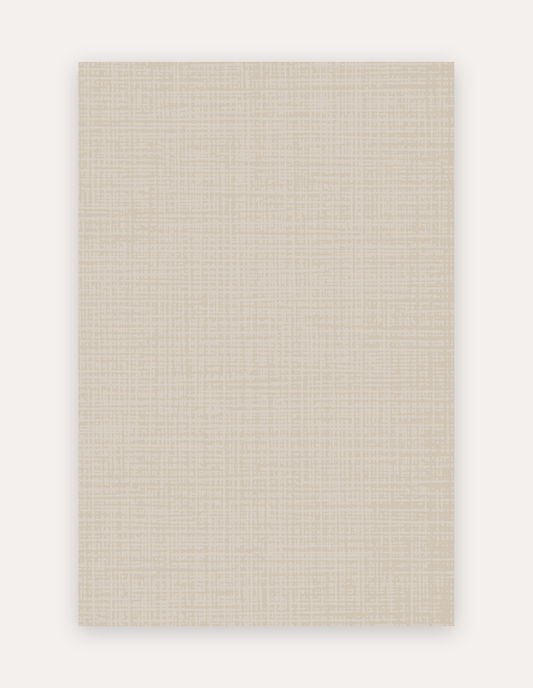
The designs are the point as much as the build. The Modern collection is where most people start, with warm, neutral palettes like Arlo Olive, Sloane Navy, and Circa Sandstone that anchor a room instead of shouting at it. Each comes in a 5×7 or 6×9, sized for the way your space actually works.
I built this because I couldn't find it. After my first son, I needed one surface large enough for a real workout and safe enough for a baby to play on, that I'd still want to look at every day. Nothing like it existed, so I spent two years making it. — Emilie
If you're choosing colors, order a swatch pack to see them on your own floor before you commit. Explore the Modern collection to find the one that fits your space.