

Core Training at Home: The Floor for Abs, Planks, and Stability Work

Core training has moved past the era of endless crunches into a broader practice that includes plank variations, dead bugs, bird dogs, Pallof presses, and stability progressions that address the deep core musculature responsible for spine and pelvic stability. The updated approach produces meaningfully better outcomes for posture, back pain, and functional strength than the ab-focused crunch protocols of previous decades.
The catch: modern core training is floor-based and time-intensive. Most home setups do not support the daily practice comfortably enough for it to actually happen. This post covers what modern core work requires from the floor, why the mat matters more than for most training formats, and what to prioritize for a core setup that supports the daily practice.
What Modern Core Training Includes
The current framework for core training combines four categories that address different aspects of core function.
Anti-extension work. Planks, dead bugs, hollow holds, and variations that train the core to resist spinal extension. Builds deep abdominal strength without the spinal flexion of crunches.
Anti-rotation work. Pallof presses, bird dogs, one-arm carries, and variations that train the core to resist rotational force. Critical for functional strength and spinal health.
Anti-lateral flexion work. Side planks, suitcase carries, and variations that train the core to resist lateral force. Addresses often-neglected obliques and QL function.
Direct flexion (used sparingly). Traditional ab work like crunches and sit-ups, used selectively rather than as the entire program.
What Core Work Puts on the Floor
Core training is almost entirely floor-based, which puts specific demands on the mat surface.
Extended plank durations. A single core session may include multiple plank holds of 30 seconds to 2 minutes each. The forearms, elbows, and toes are in direct contact with the floor throughout. Thin mats become uncomfortable within seconds.
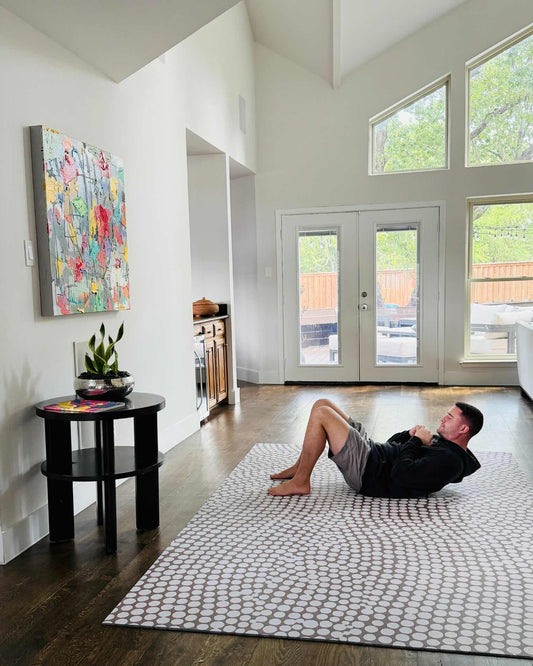
Supine sequences. Dead bugs, hollow holds, and hip lifts all happen on the back. The spine, especially the lower back, is in direct contact with the floor and needs cushion for extended durations.
Prone sequences. Bird dogs (starting position), superman variations, and prone extensions put the hip bones, ribs, and pelvis in direct contact with the floor.
Side-lying positions. Side planks, side crunches, and hip-focused work put the hip and shoulder in direct contact with the floor.
Lateral space for varied positions. Modern core work includes positions that extend beyond a standard yoga mat width. Full plank variations, wide side planks, and any exercise that involves extending the arms or legs laterally exceeds the 24-inch standard.
Why the Mat Matters More Than for Most Training
Three specific factors make the floor surface unusually important for core training.
The exercises are held rather than moved through. Unlike dynamic training where positions change constantly, core work involves extended holds in single positions. The mat has to support those positions comfortably enough for the hold to complete without joint-driven early quits.
The compliance curve is steep. Core work has strong evidence supporting daily practice, and the benefits accumulate meaningfully across weeks and months. But it is not a form of exercise anyone particularly loves. Any friction (uncomfortable floor, inadequate space) tends to reduce compliance disproportionately.
The joint contact is direct. Elbows on the floor for planks, spine on the floor for supine work, hips on the floor for prone work. There is no shoe or clothing intermediary between joint and mat.
What to Prioritize in a Core Training Mat
Five criteria for a core setup that supports the daily practice.
6mm of high-density supportive cushion. Enough to protect elbows, spine, hip bones, and knees during extended holds without becoming so soft that the surface undermines stability.
Firm enough for stability. Core work requires precise positioning. Overly soft mats reduce the neuromuscular feedback that makes core training effective.
Single-piece construction. No seams to catch during position transitions, no shifting during held positions.
Waterproof, wipe-clean surface. Extended floor contact means daily cleaning. The surface has to handle it without absorbing anything.
Adequate lateral space. Full-range core work needs more than the 24-inch width of a standard yoga mat. 5 feet by 7 feet fits most solo core practice with adequate margin.
The Swankymat Fit for Core Training
Swankymat is built for the extended floor-based practice that modern core training requires. Single-piece non-toxic high-density foam with 6mm of supportive cushion handles extended plank durations, supine sequences, and prone work without joint pain. The firm density preserves the stability required for precise positioning. The waterproof surface handles daily use and cleaning.
Available in Oversized 5x7 for solo core practice, Oversized 6x9 for larger practice spaces or shared training, and the rollable Studio Mat for portable core work. For a broader look at core training within a full home practice, the post on carving out a home wellness space covers layout and integration.
For material feel and cushion response before ordering, the swatch pack ships three real samples with $15 off the first Oversized mat.