


Home Gym Lighting Ideas for a Designed Home
Home gym lighting is usually the last thing a homeowner specifies and the first thing an interior designer changes. The default setup, one overhead fixture on a single switch, is the choice that quietly undermines the rest of the room. Even a beautifully sourced wellness room with the right storage and the right mat starts to read as clinical the moment the overhead comes on.
This is a walk through what layered lighting actually looks like in a wellness room, why the default fails, and the choices that make the room adjust to the workout instead of the workout adjusting to the room.
Why single-source overhead lighting fails the wellness room
Overhead lighting has one job. Fill the room evenly for tasks that need visibility. Cooking, cleaning, and reading a document all get done under it. Working out gets done under it too, and it is the wrong light for the work.
Overhead lighting flattens the room visually. Every surface reads the same, every color washes out slightly, and the room stops feeling like a room. It also runs at full intensity from the moment it comes on, so a six a.m. session and a nine p.m. restorative session both happen under the same commercial-grade brightness. Neither one is served by it.
Designers replace or layer the overhead with fixtures that vary in height, warmth, and intensity. The result is a room that adjusts to the moment.
The three-layer specification
A designer-built wellness room typically holds three lighting layers.
Layer one is ambient light. Natural daylight, filtered through window treatments that control glare, plus indirect light from cove lighting or wall sconces. The ambient layer sets the base level and does most of the work during the middle of the day. If the room has meaningful natural light, the ambient layer is largely handled and the specification focuses on managing brightness at the extremes.
Layer two is task light for the primary movement zone. A floor lamp or a directional wall sconce aimed at the mat area, warm-toned rather than daylight-white. The task light comes on during morning sessions when the ambient layer is still low, and it provides the focused warmth that makes early workouts feel like a considered start to the day rather than a fluorescent alarm.
Layer three is accent light for atmosphere. A small table lamp on a considered console, a candle on a shelf, or a single low pendant. The accent layer is what turns evening restorative or breathwork into an environment rather than a chore. During daytime workouts it is off. During a slow evening session it does most of the work.
Dimmers are the piece most homeowners skip
The single specification change that does the most work in a wellness room is putting the overhead fixture on a dimmer. It costs a few hundred dollars during electrical work and it changes the room's entire capability.
An overhead on a dimmer becomes usable across the day. Full brightness for cleaning or for a mid-day session where you need to see equipment. Half brightness for a morning strength routine. Low brightness for evening yoga. The room adjusts, and the same fixture handles it all instead of being either on or off.
Adding the dimmer during a whole-house renovation is straightforward. Adding it later is a small electrical job. Either way, it is the highest-leverage lighting change most wellness rooms need.
Warm color temperature over daylight-white
The default LED bulb is often 4000K to 5000K, described as daylight or bright white. It reads as clinical in a residential context, and it is the color temperature that most obviously codes the wellness room as a commercial gym.
2700K to 3000K, described as warm white or soft white, reads as considered interior lighting. The room feels like part of the home. A warm-white overhead on a dimmer, paired with warm-white task and accent lighting, is the temperature specification that makes the room feel residential rather than institutional.
Managing natural light without eliminating it
Windows in the wellness room are usually an asset. Natural light supports morning workouts, brightens the space visually, and reduces the need for daytime artificial lighting. The design consideration is managing glare on the mat surface and on any screen used during class content.
Sheer window treatments filter direct sunlight while preserving the visual openness. Roman shades or roller shades on a lift mechanism allow full closure for restorative sessions or streaming classes. Blackout is rarely necessary in a wellness room. Filtering is usually sufficient.
Where the mat fits into the lighting decision
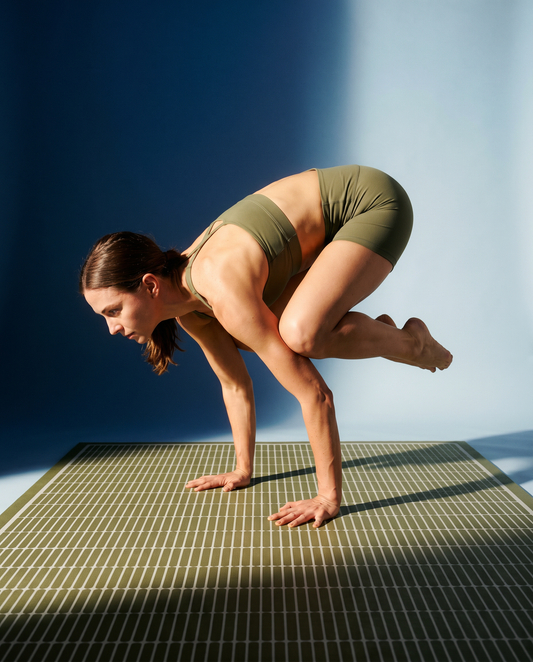
The mat surface interacts with the lighting more than most homeowners expect. A glossy mat reflects overhead light and creates hot spots that show up in videos and on the floor visually. A matte mat with a hand-drawn pattern absorbs the light quality of the room and takes on the palette shift as the lighting layers change through the day.
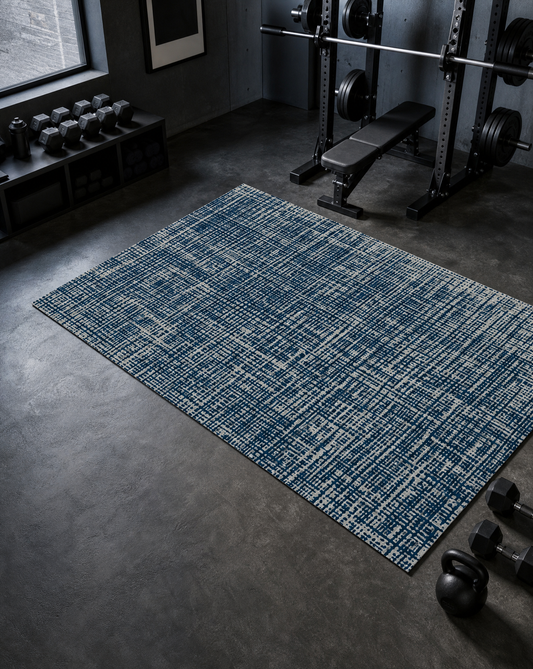
The palette of the mat also determines how the room reads under warm-white lighting. Cool tones can flatten under warm light. Warm-toned mats (camel, olive, sage, midnight blue with warm undertones, cream, sand) tend to hold their character across the day.
Where Swankymat fits
Swankymat is built with a matte hand-drawn patterned surface that works with layered residential lighting rather than against it. Single-piece construction with no bonded top layer that would peel or glare. Six millimeters of dense supportive cushion. Restrained warm-toned palettes across the line (Rhodes Camel, Ellis Sage, Arlo Olive, Sloane Midnight, Circa Cove, Sloane Forest Green) that hold up across warm-white light through the day.
Available in Oversized 5x7 for a defined-zone wellness room, Oversized 6x9 for a full-room anchor, and the rollable Studio Mat for smaller footprints.
The Confidence Path to the Right Mat
Two low-risk starting points work well for anyone weighing the decision.
The Perfect Match Quiz takes sixty seconds and recommends a colorway and size based on your space and how the room will be used. Free.
The swatch pack ships three real material samples for $15, credited to your mat. Feeling the samples in the room's actual light is the reliable way to see how the mat holds up across the lighting layers. Ordering swatches first unlocks the Perfect Match Guarantee. If you don't love your mat when it arrives, switch it within seven days, completely free. Swankymat pays return shipping. Swatch it, switch it free.
The Swankymat Promise
Every Swankymat is backed by four commitments. Built to Last, Backed for a Year, a one-year quality guarantee on manufacturing defects and premature wear. Easy 30-Day Returns, so you can live with your mat and send it back within thirty days if it is not right. Spills Happen, waterproof and wipe-clean, so real life wipes right off. Perfect Match Guarantee, for anyone who orders a swatch pack first. Free shipping on all orders in the Continental US, including HSA and FSA orders through TrueMed.