Home Gym Planning for a Real January Start
You already know what happens in January. The gym parking lot fills up for three weeks, then thins out. The new routine lasts until a cold morning, a late meeting, or a weekend that got away from you. By mid-February, the plan is quiet. The treadmill becomes a drying rack. The dumbbells live under the couch.
Most planning advice tells you to buy equipment, pick a program, and commit. That works for the people who were already going to work out. For everyone else, the reason the plan dies is not willpower. The space in your home does not invite you in. You have to move a coffee table, find a towel, kneel on hardwood, and talk yourself into something uncomfortable before you have even started.

Why January starts fail in October
The honest timeline on a home gym is longer than most people admit. Picking a corner, measuring it, clearing it, and buying the right pieces takes two or three weekends if you are doing it around a normal life. If you wait until the week between Christmas and New Year's, you are stacking furniture decisions on top of travel, family, and the general fog of the holidays. Then January arrives and you still do not have a space.
October is a better moment because the house is already settling into its indoor rhythm. You know which room gets morning light. You know where the dog really sleeps. You know which corner stays quiet at 6:30 a.m. The decisions you make now are decisions you'll live with, not decisions you crammed in on New Year's Day. By January 1, the corner is already a working corner, which means your first workout of the year is the thirtieth, not the first.
Pick the corner first, not the equipment
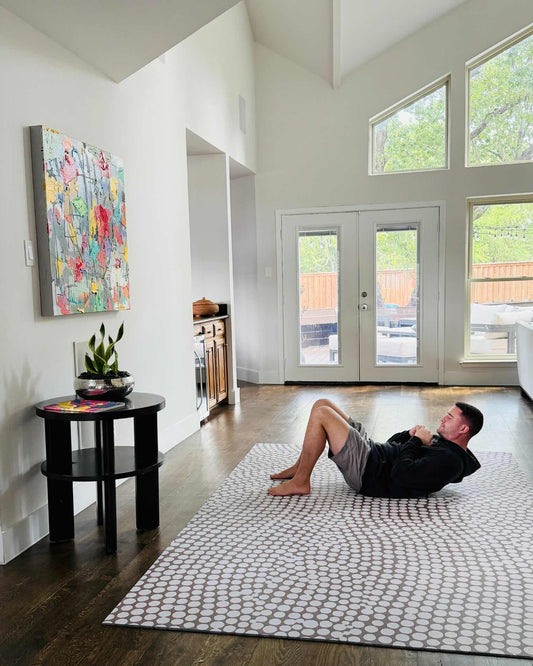
A home gym begins with a footprint, not a dumbbell set. Walk through the rooms you actually use and look for a quiet rectangle, five by seven at minimum, six by nine if you have the room. You want a stretch of floor you can leave open. Not an aspirational conversion of the guest room. A real square of real floor, in a room you already live in.
Living rooms work. Bedrooms work. A finished basement with good light works. A spare office works if the desk can shift two feet. The test is simple. Can you be on this floor in under ten seconds from the time you decide to move? If the answer is yes, that corner is a home gym waiting to be set up. If the answer involves moving a chair or clearing laundry off the floor, you already know what will happen on a Tuesday morning in February.
The foundation question nobody plans for
Once you have the corner, there is a floor underneath it, and that floor matters more than any piece of equipment you are about to buy. Hardwood looks lovely and feels brutal on a shoulder press. Tile is colder than you remember. Carpet looks forgiving and traps every bead of sweat and every speck of chalk you drop on it. The common assumption, that a standard yoga mat will handle the whole room, is the assumption that undoes most home gym plans.
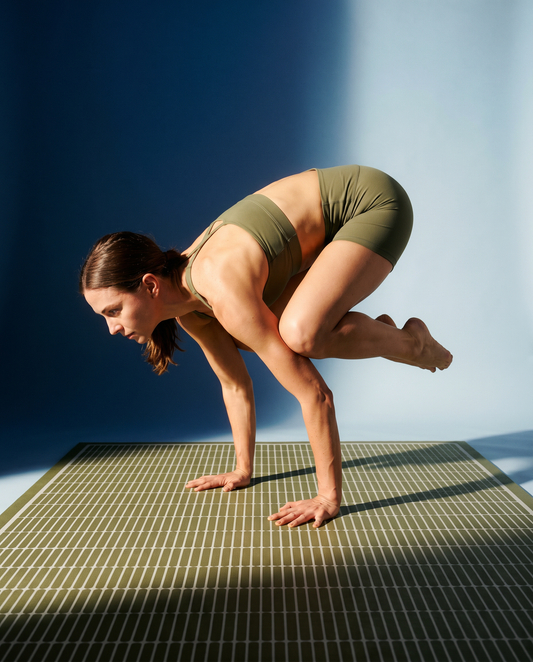
A standard yoga mat is a 24 by 68 inch sliver. Half-moon pose runs off the end. A plank slides. A kettlebell swing lands on the hard floor beside it. The yoga mat was never built to be the floor of a room. It was built to carry one body through one sequence.
What you want in a home gym is a floor that greets you. Supportive, cushioned, large enough that you can lie down on your back with both arms out and still be on the mat. Non-toxic high-density foam does this without the gym-rubber smell that follows cheap tiles into a room. A real foundation lets you leave the dumbbells on it, roll the foam roller across it, and sit down with coffee between sets without worrying about the floor beneath you.
What to buy in October versus December
Equipment is the easiest part and the part people over-buy. In October, you want three things in the corner you picked. A foundation mat large enough to be the floor. One set of adjustable dumbbells, or a pair you know you'll use. A simple set of resistance bands. That is it for the start.
In November, add one tool you have specifically missed in your workouts. A kettlebell. A pull-up bar. A step. In December, add the thing you'll want in January once the routine is real, which is often a mirror, better lighting, or a small shelf that keeps the mat corner from reading as clutter.
The compounding part is simple. If you set the corner up in October, by January 1 you have already used it. The habit is not a resolution. The habit is a continuation of something you already started.
The room still has to look like a room
A home gym fails a lot of women on aesthetics. The black rubber mat and the pop of neon logo and the cheap foam puzzle tiles. If the corner clashes with the rest of the home, the home wins. The gear gets stored. The habit dies. The space the gym was supposed to be goes back to being a living room with laundry on the chair.
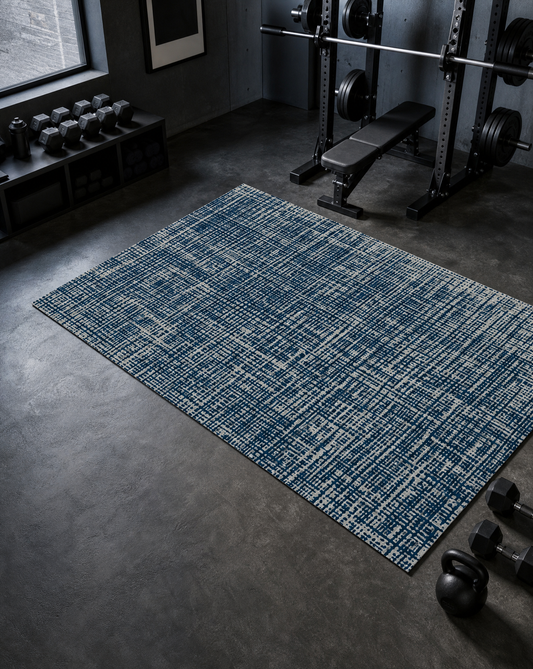
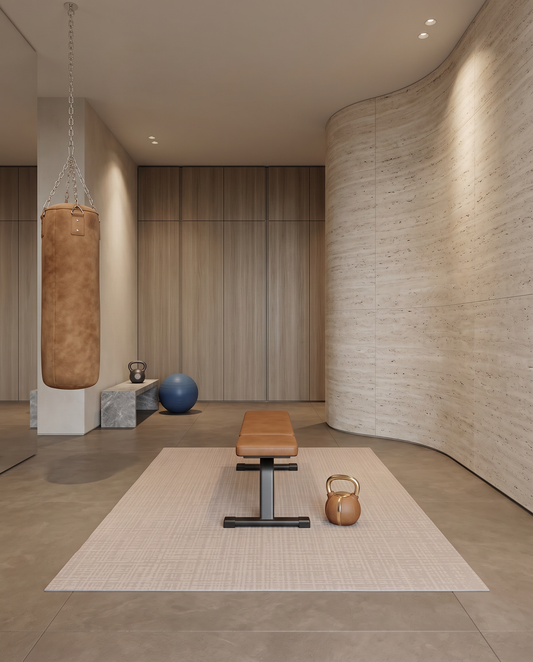
The surface you choose takes up the biggest visual footprint of anything you are adding, bigger than any dumbbell, bigger than any resistance band. If it reads as gym equipment, your room reads as a gym. If it reads as a textile that works for a workout, your room still reads as a home. That one choice decides whether the corner is left out all week or shoved behind the couch on a Saturday.
The 60-day timeline worth writing down
If you want a concrete picture, here is the shape of the two months between now and the end of the year. Week one, measure the corner. Week two, order the foundation mat and clear the floor. Week three, the mat arrives and you leave it rolled out. Week four, you do your first short routine on it. By mid-November, the corner is a working corner. By mid-December, the routine is part of a week, not an aspiration.
The reason this timeline works is that none of it is heroic. You are not committing to a six-day program on a mat you ordered last Tuesday. You are letting the space itself build the habit, one week at a time, in a season where the house is quiet enough to notice.
Where Swankymat fits in home gym planning
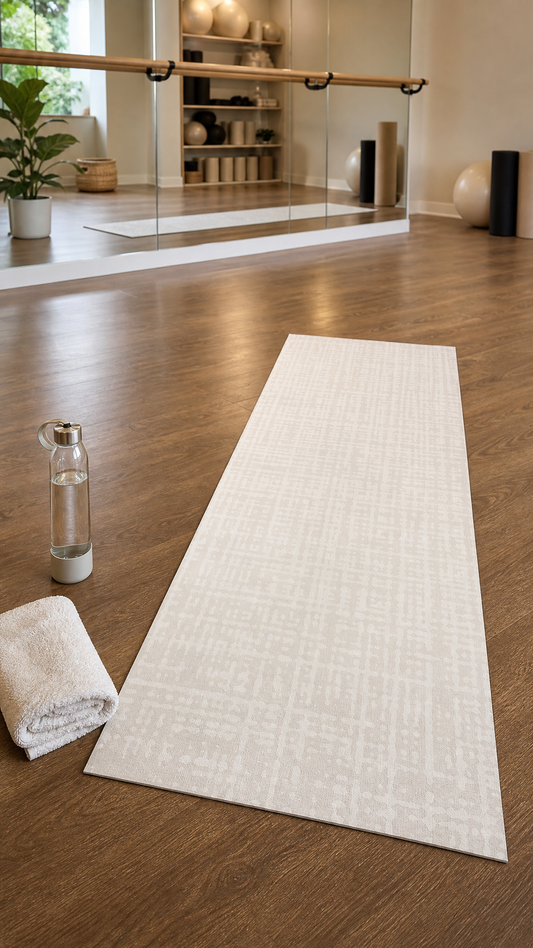
The Rhodes Camel Oversized Mat is the piece that lets the corner read as a room. A warm camel tan, soft under knees, dense enough for weights, big enough that a side plank stays on the mat. In a 5 by 7 it anchors a living room corner. In a 6 by 9 it carries a full workout, a yoga flow, and a foam roller session without a single move running off the side.
You can leave it rolled out. You can slide it under a chair in a smaller room. You can place it in front of a window and the color stays in conversation with your rugs and your wood. The mat is the foundation. The corner is the gym. The room is still your home.
The Confidence Path to the Right Mat
Three steps keep this simple.
Start with the Perfect Match Quiz. Three questions about your room, your floor, and your routine. It points you toward the color and size that fits your home instead of asking you to guess.
Then order a swatch pack. Fifteen dollars, credited back to your mat when you buy. You get real foam, real color, and real texture in your hands, under your actual light, next to your actual wood.
And once your swatches arrive, you are covered by the No Sweat Guarantee. If the mat shows up and you do not love it, swap it or send it back for a full refund within 7 days.
The Swankymat Promise
Four commitments on every mat.
- Non-toxic high-density foam with Greenguard Gold certified inks, so the mat is safe to live with every day.
- Supportive cushion that holds up under knees, elbows, and planks without going flat.
- A waterproof wipe-clean surface that handles water, dust, chalk, and the occasional spilled coffee.
- No Sweat Guarantee, for anyone who orders a swatch pack first. Swap it or send it back for a full refund within 7 days, no sweat.