


Home Gym Storage Systems That Read as Furniture
Walk into most home gyms and the visual signal is the same. Weights on the floor. Straps and bands in a plastic bin. A foam roller propped against the wall. Yoga blocks stacked on top of a bench. The equipment itself is functional. The storage is not.
Stored equipment does more damage to the room's aesthetic than any single design choice. A beautifully specified wellness room with a good mat, warm lighting, and considered palette can still read as a workout corner if the storage is stacked plastic. Fixing this is one of the higher-leverage changes any home gym can make, and the fix has less to do with buying more storage and more to do with treating storage as a design category rather than a container problem.
Why plastic bins are the default and why they fail
Plastic bins are cheap, available at any general retailer, and functionally adequate. They hold small equipment. They stack. They can be labeled. Every home fitness starter kit page recommends them, and most home gyms have at least one somewhere in the setup.
The problem is that plastic bins read as garage storage in a residential context. Even opaque plastic in a neutral color signals utility rather than intention. The bin becomes the visible surface, and the eye reads it before it reads the mat, the room's palette, or the lighting.
Designers replace plastic with natural fiber (woven grass, seagrass, rattan), wood (cabinetry or open shelving), fabric (canvas or linen storage baskets), or leather (small trays and catchalls). Any of these materials reads as considered decor rather than as utility.
The four categories of home gym equipment worth solving for
Storage requirements break into four categories, and each has a different design answer.
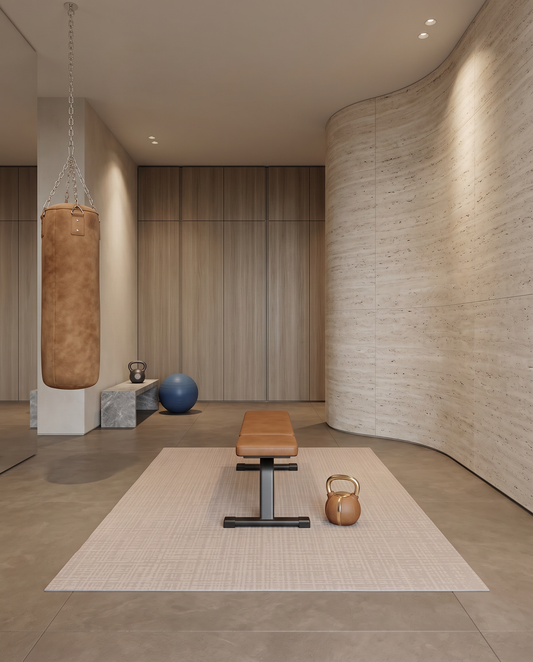
Weights. Dumbbells, kettlebells, hand weights. Heavy enough that the storage has to be structural. Best solved with open wood shelving that displays the weights as part of the room's material palette. Wood-handled dumbbells or powder-coated kettlebells in muted colorways become part of the design rather than gear to be hidden.
Small props. Yoga blocks, straps, bands, foam rollers, lacrosse balls, massage tools. Small enough to disappear into a considered container. Best solved with natural fiber baskets on the same open shelving, or in a closed cabinet compartment.
Mats and rolled equipment. Rolled yoga mats, foam rollers, resistance bands, jump ropes. Best solved with wall-mounted racks in wood or matte metal, or in a tall narrow cabinet. Wall mounting keeps the floor clear and makes the equipment easy to grab.
Larger equipment. Weight benches, larger cardio pieces, kettlebell racks. Best solved by choosing pieces that photograph as furniture rather than as gym gear. A wood-topped weight bench, a considered kettlebell rack in wood or matte metal, or cardio equipment in a neutral finish that coordinates with the room.
The design principle: storage as furniture
The rule that separates a designer-specified home gym from a functional one is that storage in the wellness room should read as furniture, not as storage. A wood shelving unit is furniture. A rattan basket is furniture. A leather tray is furniture. A plastic bin is not.
Applied consistently, this principle changes the visual character of the room. The equipment becomes part of the room's material palette. The storage stops competing with the mat, the lighting, and the palette for attention. And the room stops reading as a workout corner even before the workout starts.
Storage that opens easily is storage that gets used
The other rule worth naming. Storage that is difficult to open or close does not get used. Beautiful cabinetry that requires a two-step motion becomes cabinetry that stays closed with the equipment stacked on top. Baskets tucked into a corner become baskets that never get pulled out.
The storage that works has to be as easy to reach as it is to look at. Open wood shelving with clearly designated sections. Baskets in the primary use area rather than tucked away. Cabinets on smooth hardware that opens with one motion. The friction cost of putting equipment away has to be low enough that it actually happens.
Where the mat fits into the storage question
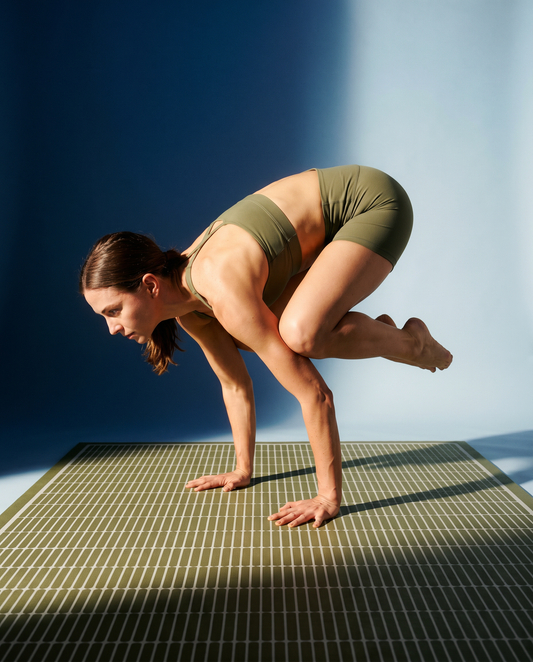
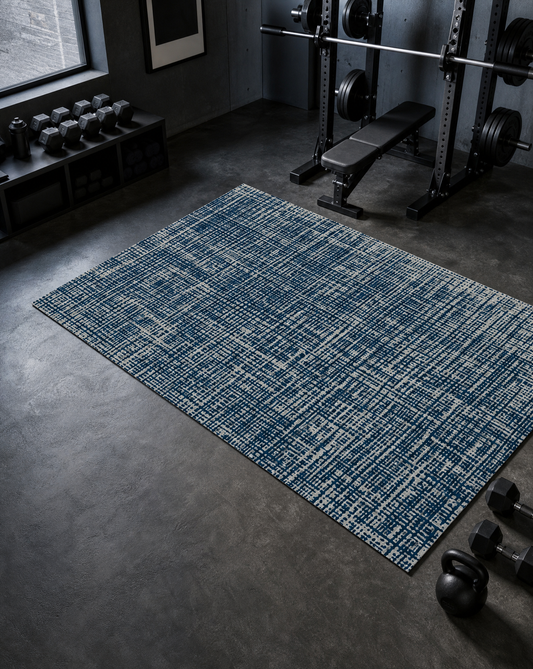
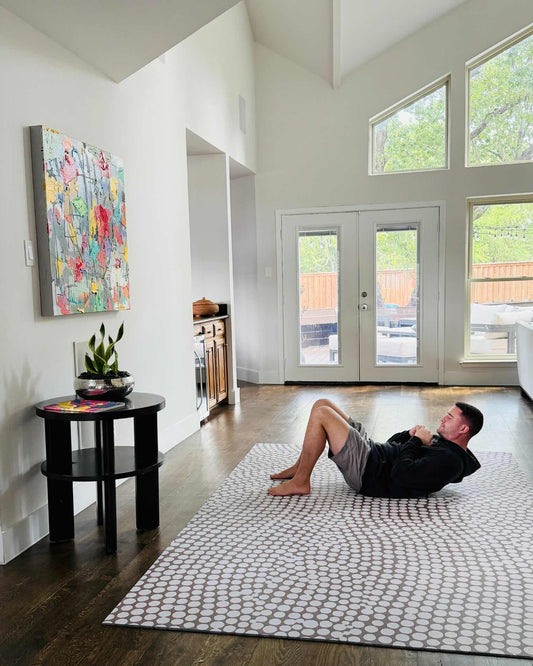
The mat is one of the few pieces of home gym equipment that solves its own storage problem by staying out. A well-chosen mat lives on the floor as the room's anchor, so it does not need to be rolled and stored between uses. This is one of the higher-leverage design decisions in a wellness room. It removes an entire storage category (mat storage) and adds a visible design element (the mat as anchor) at the same time.
The mat that gets rolled and stored between uses gets used less than the mat that stays out. Aesthetic integration is what allows the mat to stay out. Which is what allows the rest of the storage system to be simpler.
Where Swankymat fits
Swankymat is built to stay out as the anchor piece of a considered wellness room, so the storage system does not need a mat category. Single-piece construction with no bonded top layer. Six millimeters of dense supportive cushion under knees and wrists. Hand-drawn patterned designs in restrained residential palettes that coordinate with the room's material system. The waterproof surface handles real use across years.
Available in Oversized 5x7 for a defined-zone wellness room, Oversized 6x9 for a full-room anchor, and the rollable Studio Mat for smaller footprints or clients who want a portable option alongside the permanent piece.
The Confidence Path to the Right Mat
Two low-risk starting points work well for anyone weighing the decision.
The Perfect Match Quiz takes sixty seconds and recommends a colorway and size based on your space and how the room will be used. Free.
The swatch pack ships three real material samples for $15, credited to your mat. Ordering swatches first unlocks the Perfect Match Guarantee. If you don't love your mat when it arrives, switch it within seven days, completely free. Swankymat pays return shipping. Swatch it, switch it free.
The Swankymat Promise
Every Swankymat is backed by four commitments. Built to Last, Backed for a Year, a one-year quality guarantee on manufacturing defects and premature wear. Easy 30-Day Returns, so you can live with your mat and send it back within thirty days if it is not right. Spills Happen, waterproof and wipe-clean, so real life wipes right off. Perfect Match Guarantee, for anyone who orders a swatch pack first. Free shipping on all orders in the Continental US, including HSA and FSA orders through TrueMed.