


Interior Designers on Home Gyms: What the Pros Actually Get Right
The home gym used to be an afterthought room. Basement, garage, spare corner. Whatever space had nothing else planned for it got the treadmill and the black rubber flooring, and the door stayed closed most of the time.
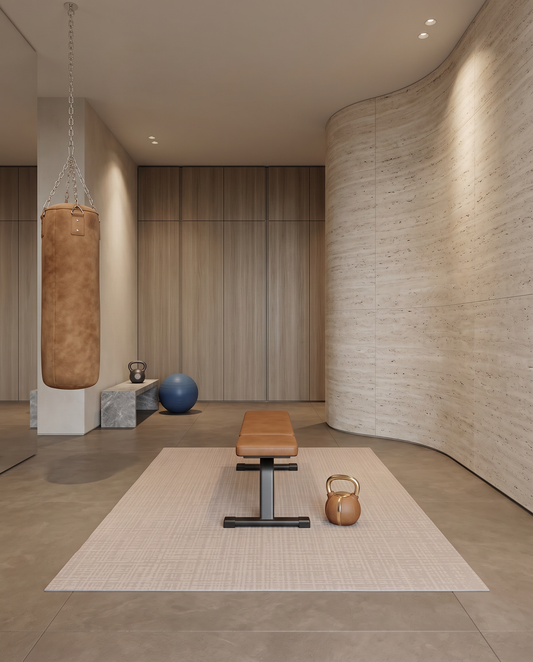
That version still exists. Most home gyms are still built that way. But over the last few years, interior designers have started treating the wellness room the way they treat the kitchen or the primary bedroom. As a considered space that has to live inside the house without breaking its logic. The homes that get it right share four choices designers make that homeowners on their own tend to skip.
The category shift that made this a design problem
Streaming fitness moved daily workouts out of the gym and into the house. Peloton, Alo Moves, Nike Training Club, and every yoga instructor with a camera trained a generation of home movers to expect the room to look the way the class looks on screen. That expectation reset what counts as an acceptable home gym.
Interior designers noticed the shift about two years before the mass-market design press did. Clients started asking for wellness rooms during whole-house renovations. Kitchen designers started running into the same question at the end of the project: what do we do with the guest bedroom nobody uses. Real estate photographers started specifically requesting the home gym in listing photos where it used to get skipped.
The room became a design brief. And design briefs run on a different rule set than functional gym setups.
The four choices designers make that homeowners skip
Palette continuity with the rest of the house. Homeowners often treat the wellness room as a separate palette. Bright accent wall, energetic color, motivational graphic. Designers pull the wellness room palette from the rest of the house so the room reads as connected instead of quarantined. Warm neutral in the primary bedroom, warm neutral in the wellness room. Deep saturated tones in the living room, deep saturated tones in the wellness room. Continuity is what makes the room feel like part of the home rather than a bolted-on gym.
Storage that reads as furniture. The biggest visual failure in most home gyms is stored equipment. Weights on the floor, straps in a plastic bin, a foam roller leaning against the wall. Designers specify closed cabinetry, open wood shelving, considered baskets. Every piece of equipment has a place, and every place looks like it belongs in a home rather than in a commercial gym.
Lighting that is not overhead-only. Overhead lighting reads as fluorescent even when it isn't. Designers layer in floor lamps, wall sconces, or considered pendants at multiple heights. The room has three light sources at minimum, on dimmers if the electrical allows. Morning sessions get warm indirect light. Evening restorative sessions get low ambient light. The room adjusts to the workout instead of buzzing overhead regardless of time.
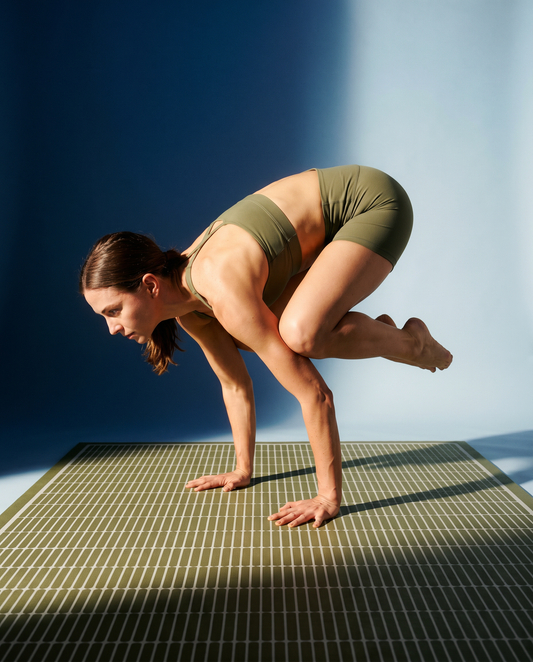
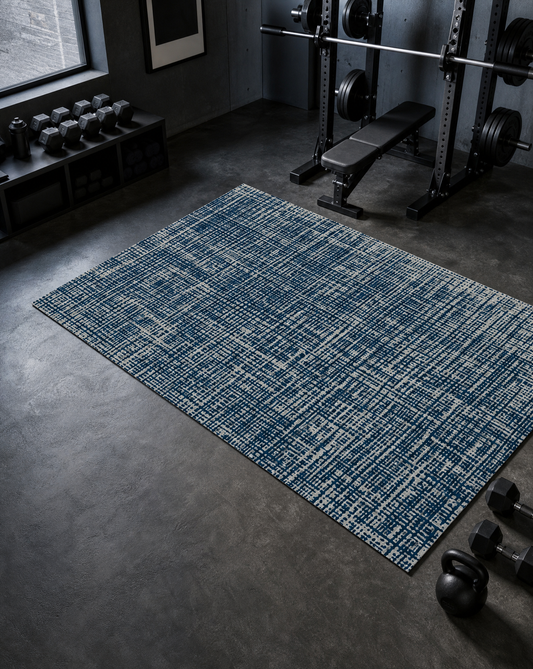
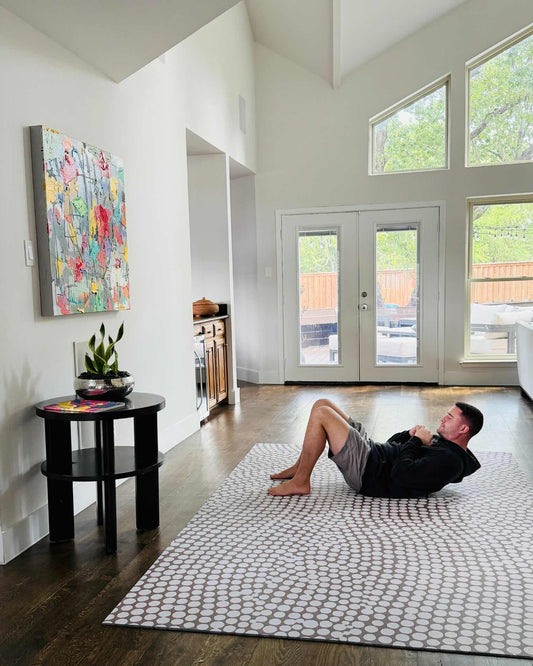
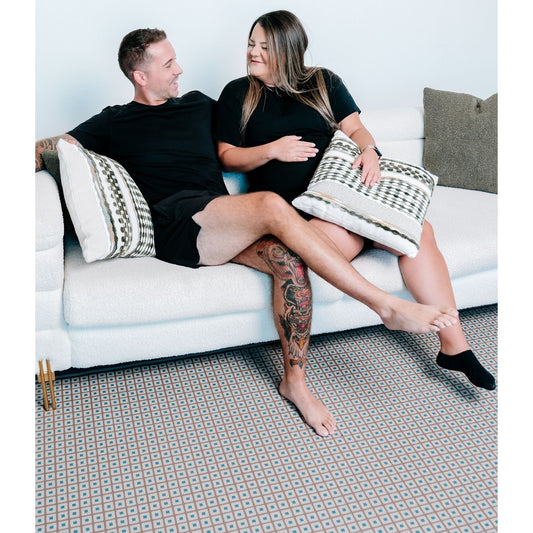
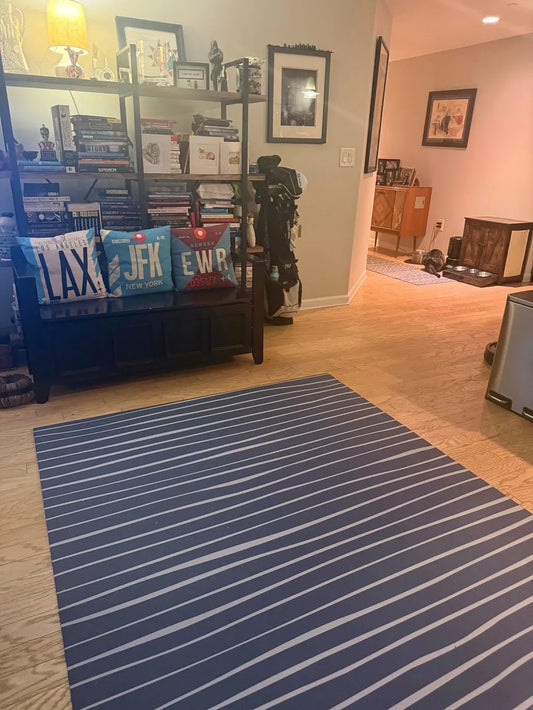
The floor surface treated as a design element. This is the choice that surprises homeowners most. The mat is not gym equipment. It is the largest visible surface in the room, and it does more aesthetic work than anything else in the setup. Designers choose a mat the way they choose a rug for the living room, with palette, pattern, texture, and size considered against the rest of the room's furniture. A hand-drawn patterned mat in a considered palette anchors the wellness room. A branded black rubber mat announces it.
Why the mat is the highest-leverage line item
Interior designers who build home gyms consistently place the mat as the anchor purchase. Three reasons.
The mat is the largest visible piece in most home gym setups. Weights, cardio equipment, storage, and props all take up less visual volume than the floor surface itself.
The mat lasts longer than any other equipment in the room. Cardio equipment cycles every five to seven years. Small equipment gets replaced or reorganized on a similar cycle. A well-built mat lasts a decade. It is the foundation piece.
The mat anchors the palette that everything else has to work with. Choosing weights, storage, and props first and then trying to source a mat that agrees with them is significantly harder than choosing the mat first and curating around it.
Where Swankymat fits in a designer-built home gym
Swankymat is built to work as the anchor mat in a designer-specified wellness room. Single-piece construction with no bonded top layer, so no seams or peel points to age visibly. Six millimeters of dense supportive cushion under knees, wrists, and hip bones. Hand-drawn patterned designs in restrained residential palettes, so the mat coordinates with the rest of the house instead of announcing itself as gym gear. The inks on the printed surface are Greenguard Gold certified for indoor air quality, which matters more when the mat stays out in a lived-in space than when it lives rolled in a closet.
Available in Oversized 5x7 for a defined-zone wellness room, Oversized 6x9 for a full-room anchor sized like a standard area rug, and the rollable Studio Mat for smaller footprints or clients who want a portable option alongside the permanent piece.
Pro Access for design professionals
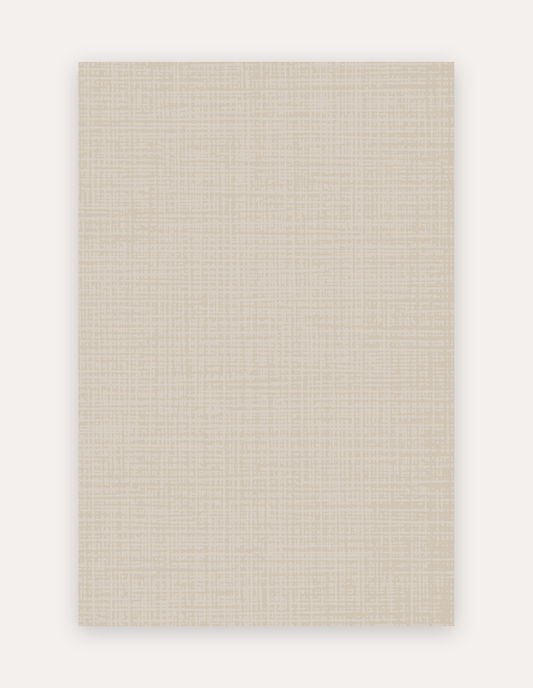
Swankymat runs Pro Access for interior designers, home stagers and realtors. The program is a value and enablement offer, not a discount program. Everyone pays full price. Pros get complimentary swatches for client projects, free personalized cards (printed four by six inches with your own artwork, shipped with the mat to your client at no cost), client-ready spec sheets (Sloane Dust and Arlo Olive available now, more colorways on request), the Styling Lookbook to share, and early access to new styles. The AR "view in your room" tool is live on every product page, so the designer can preview the mat at true size in the client's home before ordering.
Apply at swankymat.com/pages/pro-access. Reach out at pro@swankymat.com.
The Confidence Path to the Right Mat
Two low-risk starting points work well for anyone weighing the decision.
The Perfect Match Quiz takes sixty seconds and recommends a colorway and size based on your space and how the room will be used. Free.
The swatch pack ships three real material samples for $15, credited to your mat. Feeling the samples in the actual room light is the reliable way to anchor the rest of the room's palette. Ordering swatches first unlocks the Perfect Match Guarantee. If you don't love your mat when it arrives, switch it within seven days, completely free. Swankymat pays return shipping. Swatch it, switch it free.
The Swankymat Promise
Every Swankymat is backed by four commitments. Built to Last, Backed for a Year, a one-year quality guarantee on manufacturing defects and premature wear. Easy 30-Day Returns, so you can live with your mat and send it back within thirty days if it is not right. Spills Happen, waterproof and wipe-clean, so real life wipes right off. Perfect Match Guarantee, for anyone who orders a swatch pack first. Free shipping on all orders in the Continental US, including HSA and FSA orders through TrueMed.