


Kids Home for Summer: The Family Movement Corner That Actually Gets Used
Summer with kids home changes the math on home movement. School-year mornings that used to include 30 minutes on the mat become mornings that include a toddler climbing over the mat while an older child asks for breakfast. The workout does not disappear, but the conditions change enough that many parents give up on the practice until September.
There is a version of the summer setup that works. It requires designing for the family situation rather than fighting to preserve a solo practice inside a family space. This post covers what that setup actually looks like.
Why Solo Practice Fails in Summer
The single design mistake most parents make is trying to preserve a solo practice while kids are home. The kids arrive at the mat, ask questions, need snacks, or start their own version of climbing on the mat while the parent tries to focus. The practice becomes frustrated. The parent stops.
The alternative is designing the space so kids being present is part of the setup rather than the disruption. Family movement zones that assume kids will show up work far better in summer than solo zones that assume kids will not.
What the Family Movement Corner Includes
Four elements make the difference between a zone that survives summer and one that does not.
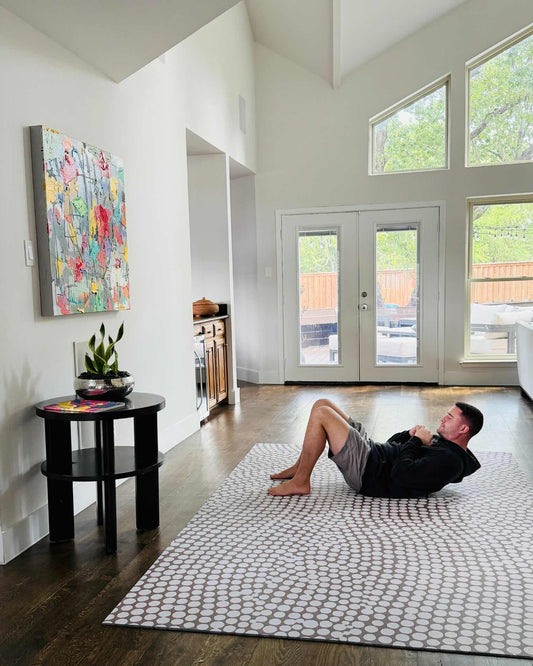
A large enough surface for two people. An Oversized 6x9 mat gives an adult room to move through a Pilates flow on one half while a toddler builds blocks on the other. A 5x7 works if the toddler is small enough or the child is old enough to sit on the edge with a book. Foam tiles do not work; kids move them constantly.
A basket of kid-adjacent movement props. A small Pilates ball for the older child to roll on, a resistance band that turns into a jump rope, a foam roller that becomes a balance beam. Kids interact with props they can see. A basket of kid-approved items nearby keeps them near the mat rather than wandering off.
A shared activity option. A yoga sequence adapted to include kids (down dog, cat-cow, tree pose), a movement game (frog jumps, bear crawls, plank contests), or five minutes of dancing at the start of the session. Involvement produces cooperation. Exclusion produces disruption.
An accepted time constraint. Twenty minutes with kids present is a realistic session length. Sixty minutes with kids present is a fantasy. Design the practice for what actually fits the summer conditions.
A Summer Family Session Structure
The structure below works for parents with kids ages two through ten. It runs 20 minutes and includes shared time and solo time.
5 minutes: Family warm-up. Cat-cow together, down dog and up dog, tree pose (kids love this one), a few silly animal walks (bear crawl, crab walk, frog jump). The kids are engaged, laughing, and warmed up alongside the parent.
10 minutes: Parent movement, kids on the mat. The parent moves through a short workout (Pilates sequence, mobility flow, or bodyweight strength circuit) while the kids do something quieter on the mat. Coloring books, a puzzle, a small toy, or a story audiobook works. The rule is proximity, not perfect stillness.
5 minutes: Family cool-down. Legs up the wall, a body scan the parent narrates aloud, or a short stretch together. Ends the practice with connection rather than separation.
For more on the multi-use case for a family floor surface, the post on a mat that supports play, movement, and everyday life covers the overlap in detail.
What Works for Different Ages
Toddlers (18 months to 3 years). Sensory play works better than instruction. A small ball to roll, a stuffed animal to bring to yoga poses (Cat pose for the cat), and a lot of narration. Expect them to leave the mat and come back several times per session.
Preschoolers (3 to 5 years). Structure with variation. A five-part yoga sequence (five animal poses) works well. A movement song. Simple imitation of the parent for two-minute stretches.
School-age (6 to 10 years). Can hold longer independent stretches. Give them their own version of the workout (five bodyweight movements at their level), or let them practice something they want to try (handstands against a wall, jumping rope, cartwheels if the space allows).
Where the Mat Fits the Family Setup
The mat has to survive a lot in a family setup. Sweaty adult workouts, spilled water, marker accidents, food, and daily kid use. Swankymat is designed for this scenario. Single-piece non-toxic high-density foam construction, waterproof wipe-clean surface, Greenguard Gold certified inks. The 6x9 Oversized fits two people comfortably. The 5x7 works for smaller families or specific zones.
Browse the baby and family play mats collection for the patterns most often chosen by families with kids at home. For more on the case for a mat that supports both kids and adults on the same surface, the post on the best mat for play and workouts covers the multi-use argument.