Large Yoga Mat Sizes and What Size Actually Fits

You've been doing yoga on a standard mat for a while, and something keeps nagging you. Your hands slip off the top edge in downward dog. Your knee hangs off the side in pigeon. When you flow, you have to shuffle backward every third pose to find the mat again. The standard size wasn't built for your body; it was built for a studio aisle where mats line up like library books.
So you start searching for a large yoga mat, and the first results are mats that are a few inches wider, maybe a few inches longer. That's a nudge. If you've outgrown the standard, you've probably outgrown the halfway house too. The question is which size gives you room to flow without accounting for the mat.

Why standard yoga mats run short on real humans
The classic 24 inches by 68 inches was built around studio economics. More mats, less aisle, more students. It was never built for a six-foot body in warrior two, and it was never built for anyone who likes to do side-angle work with a long back leg. If you're taller than five-eight, you've been renting a mat your whole yoga life.
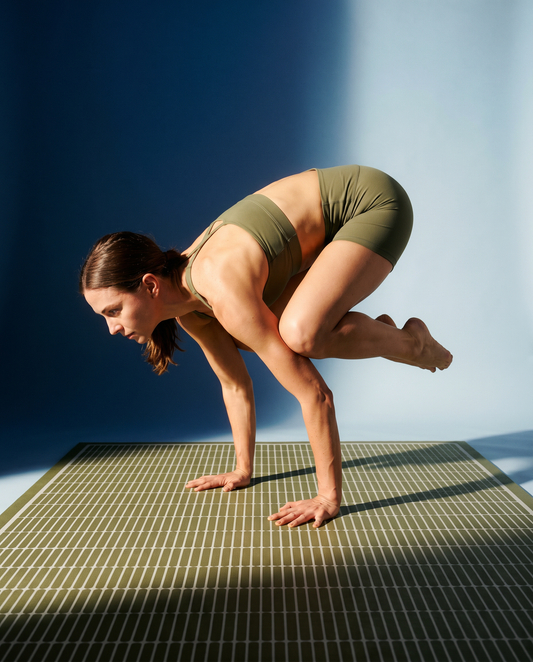
A larger mat gives you three things a standard can't. It gives you full extension in your longest poses. It gives you lateral room so you can hold a stance without collapsing to stay on the surface. And it gives you a visual field that says this is yours, which quietly changes how long and how often you want to be on it.
The sizes worth considering
Think of large yoga mats in three bands. The slightly-oversized band is around 72 to 74 inches long and 26 to 28 inches wide. A fine fix for a tall person doing a standard flow with no props, no sprawl. The oversized band starts at 60 inches wide and seven feet long. This is where room for a prop-and-pose combo opens up: blocks on the mat, bolster on the mat, child's pose with your arms fully out in front of you. The extra-oversized band is six feet by nine feet. This is a floor you can live on, hold a long-leg flow on, do a Pilates mat series on with your head and feet both on cushion, or share with a partner for restorative work.
Match the size to how you use the mat, not to the ceiling of the room. The ceiling is almost never the problem; the problem is the mat ending where your body does.
What a 5x7 actually fits
A five-by-seven handles a solo flow with room to spare. You can take warrior two with a long stance and still have cushion under your front foot and your back heel. You can lie flat in savasana with your head on the mat and your feet comfortably inside the edge. Props stay on the mat. You stop choreographing around the surface and start moving on it.
The 5x7 also doubles as a floor for seated meditation, foam rolling, or a quick bodyweight workout. If your morning routine is varied, this is often the size that disappears into your day.
What a 6x9 opens up
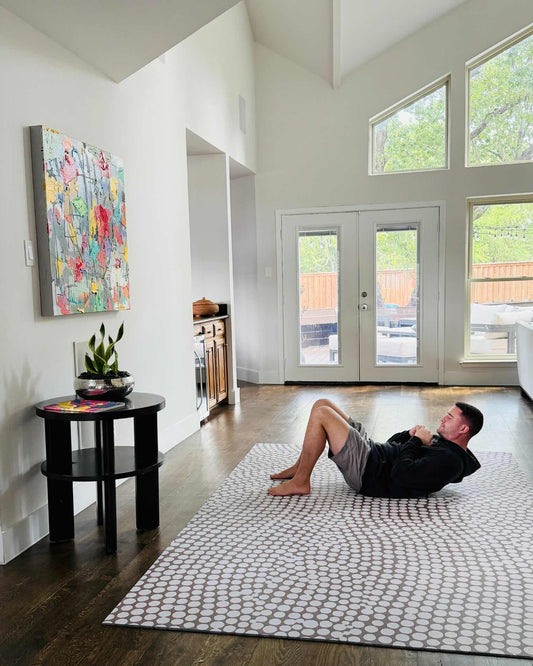
Six by nine feet is a different experience. Lie down diagonally and your fingertips still find cushion. Teachers, you can demo a pose and have a student on the mat with you. For long-form routines, you can set out blocks, a bolster, and a strap and still have mat left to move through. Side-to-side movement, which is the quiet injury risk in home flows done on a standard mat, lives entirely on the surface.
Six by nine is also the size that makes two-person work possible. Partner yoga, assisted stretching, a shared cool-down at the end of a run. The mat becomes an object the household uses, instead of a solo tool that lives in a closet.
Pattern and color matter more than you think
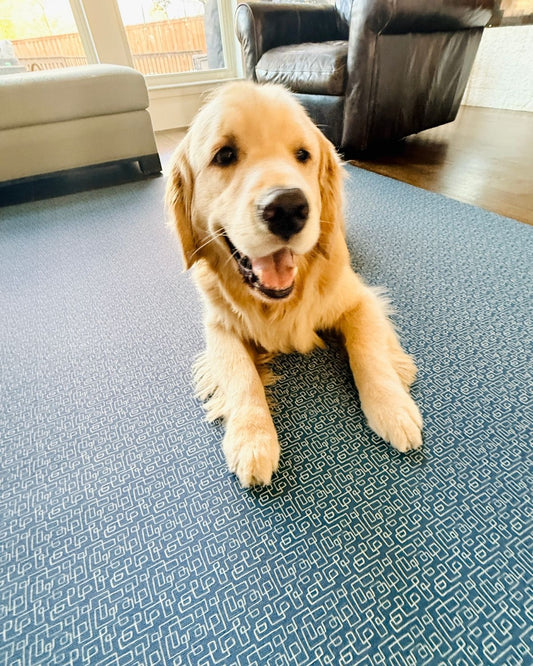
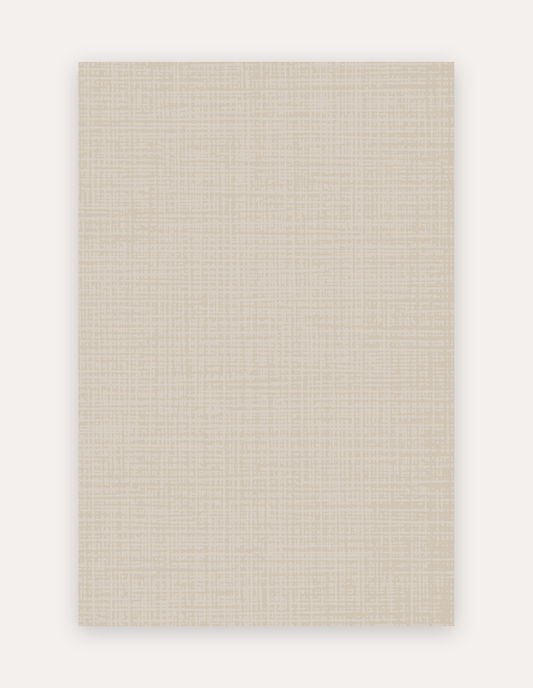
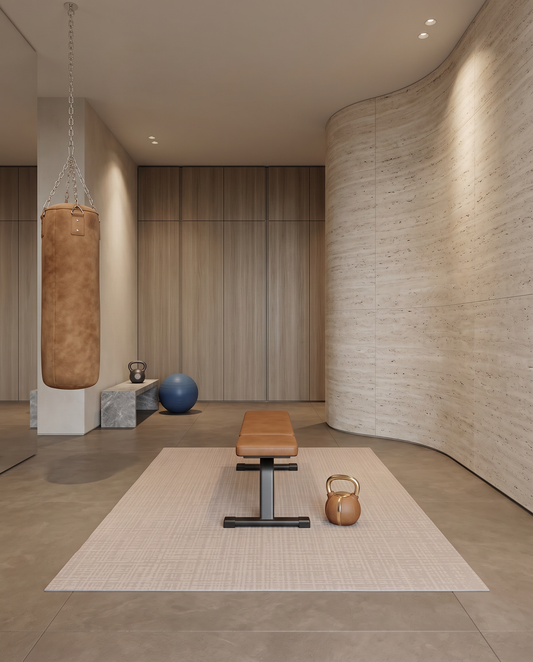
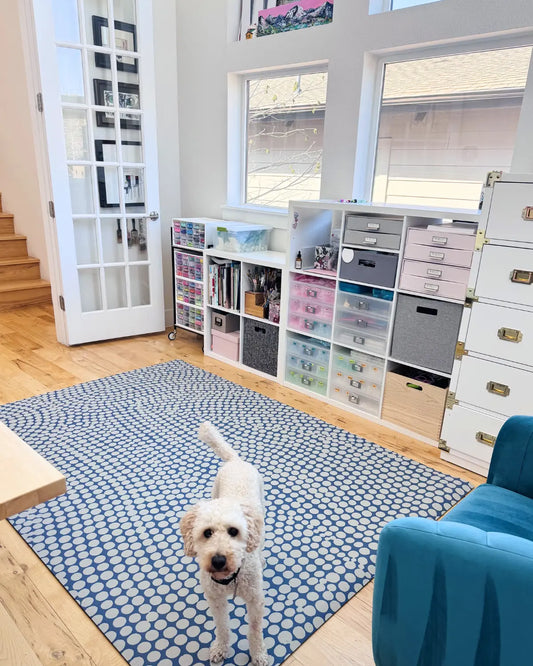
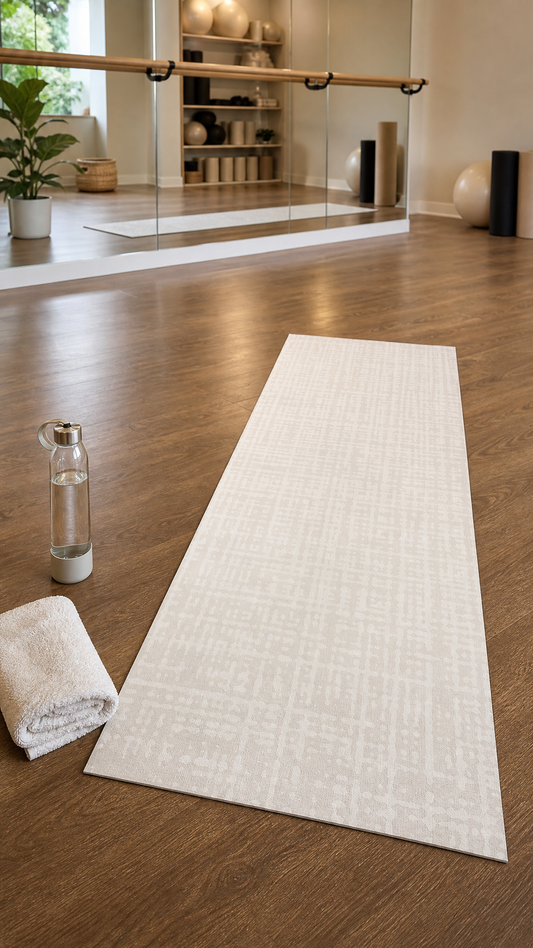
A large yoga mat lives in the room. It stays out. That means the pattern and the color are doing visual work the entire day, beyond your flow. A quiet, neutral weave in a soft dust tone sits in a bedroom or living room and reads like a rug, like decor. When the mat belongs in the room, you don't put it away. When you don't put it away, you use it more.
The practical knock-on is huge. The biggest factor in whether a home yoga routine sticks is grip, thickness, and brand far less than one quiet variable: whether the mat is already down when you walk by it. A beautiful mat left out gets used. An ugly mat gets rolled up.
How to pick between 5x7 and 6x9
Three questions decide it. First, how long is your tallest extension? If you're over five-nine, the 6x9 lets you lie flat on the diagonal with cushion under your head and heels. Second, do you use props? Blocks, straps, and a bolster eat about two square feet of mat during a prop-heavy flow. The 6x9 keeps the props on cushion and your body on cushion at the same time. Third, where will the mat live? A 6x9 anchors a room. A 5x7 fits inside most rooms without rearranging the furniture around it.
Where Swankymat fits in a large-size yoga setup
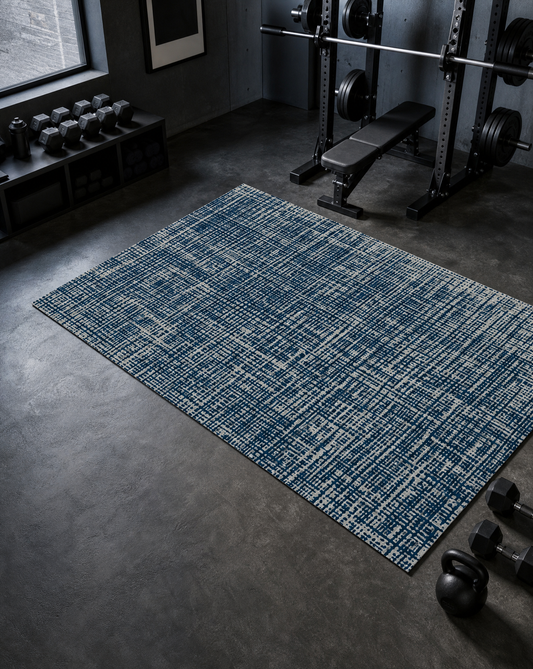
Sloane Dust is our bestseller because it answers both halves of the question: a larger mat that looks like it belongs in your home. The dust crosshatch is a soft neutral that reads as warm linen on a hardwood floor. It settles a room, instead of announcing itself. On it, your body gets the full six-by-nine or five-by-seven footprint, so flows stretch without you editing the shape to stay on the surface.
Underneath, Sloane Dust is built on non-toxic high-density foam that supports your knees in low lunge, your spine in bridge, and your head in a long savasana. The surface is printed with Greenguard Gold certified inks. One piece, flat, grippy underfoot, calm to look at. It stays out, and the yoga happens because of it.
The Confidence Path to the Right Mat
Picking a mat you'll stand on every day deserves more than guesswork. The Swatch Pack is $15, credited back to your mat, and it's the simplest way to see how a color reads in your room, on your floor, in your light. Hold the fabric-weight prints against the rug, the sofa, the chair you reach for most. The one you keep looking at is the one to order.
If you'd rather we point you toward a shortlist, the Perfect Match Quiz asks a handful of questions about your floor, your room, and the kind of movement you do, then matches you to the two or three mats most likely to feel right. Short, honest, useful.
Start with the Swatch Pack and let the room decide.
The Swankymat Promise
Non-toxic, high-density foam. Supportive cushion built to be stood on, kneeled on, lived on. Odor-free out of the box.
Design-first colorways. Patterns and tones that read like a rug, so the mat belongs in your living room, your bedroom, your office.
Greenguard Gold inks. The print layer is certified for low chemical emissions, so what you see on top isn't off-gassing underneath you.
No Sweat Guarantee, for anyone who orders a swatch pack first. Swap it or send it back for a full refund within 7 days, no sweat.