

Restorative Yoga at Home: A Quiet Practice for Stressful Weeks

Restorative yoga is the opposite of most yoga practices marketed online. There are no flows, no transitions, no heat. The practice consists of six or seven supported poses, each held for five to ten minutes, with props (bolsters, blankets, blocks) used to fully release the body. The nervous system shifts from sympathetic activation to parasympathetic rest, which is the actual mechanism for stress relief.
The reason restorative practice belongs in the conversation right now is that most people who exercise at home are doing the opposite: short, intense, productivity-shaped sessions. Adding a single restorative session a week tends to produce sleep, mood, and recovery benefits that are difficult to achieve through more activity.
What Restorative Yoga Actually Does
The autonomic nervous system has two main branches. The sympathetic branch handles activation, alertness, and stress response. The parasympathetic branch handles rest, digestion, and recovery. Most adults spend the bulk of the day in some level of sympathetic dominance, which is appropriate for active hours but harmful when sustained.
Restorative yoga, through long supported holds and slow breathing, shifts the nervous system into parasympathetic mode. The measurable effects include lower heart rate variability, reduced cortisol, slower breathing, and improved sleep quality on the night of the practice and often for several nights after.
It is not a workout. It is the recovery side of training, the same way sleep is the recovery side of being awake.
Six Poses That Cover the Essentials
The sequence below works as a complete 30-minute practice. Hold each pose for five minutes. Most poses require a bolster or a folded blanket and one or two pillows.
1. Supported Child Pose (5 minutes)
Kneel with knees wide and big toes touching. Fold a bolster or two pillows in front of you and lay your torso forward over the support, head turned to one side. Switch the head turn at 2.5 minutes.
2. Legs Up the Wall (5 minutes)
Sit sideways next to a wall, swing your legs up, and lie back. A folded blanket under the hips adds support. The simplest restorative pose and one of the most effective for stress relief.
3. Supported Reclining Bound Angle (5 minutes)
Sit with the soles of the feet together and knees out to the sides. Place a bolster lengthwise behind you and lie back. Pillows or rolled blankets under each knee provide hip support.
4. Supported Bridge (5 minutes)
Lie on your back with knees bent. Slide a block (or stack of folded blankets) under the sacrum so the hips are passively supported above the floor.
5. Supine Spinal Twist (5 minutes, 2.5 each side)
Lie on your back, draw one knee across the body, and let it rest on the floor or on a pillow. Extend the opposite arm and turn your head toward it.
6. Final Rest with Bolster Under Knees (5 minutes)
Savasana, with a bolster or rolled blanket under the backs of the knees to release the lower back.
The Setup Matters
Restorative practice depends on the space supporting it. Three elements make the difference between a session that actually settles the nervous system and one that does not.
Lighting. Dim is better than bright. Lamps over overhead fixtures. Candles if you like them.
Sound. Quiet, or low ambient sound. Restorative playlists on streaming services tend to work well.
Surface. Cushioned enough to hold long stillness comfortably. A thin yoga mat is not enough for five-minute holds on a hardwood floor. Foam tiles work but interrupt the visual calm of the space.
A Mat for Stillness, Not Just Flow
Most yoga mat reviews focus on grip and portability, which matter for vinyasa and ashtanga but matter much less for restorative practice. What restorative practice needs is comfort across long holds. The cushion has to hold a five-minute supported child pose without the knees complaining, and the surface has to read as calm rather than competing with the practice for attention.
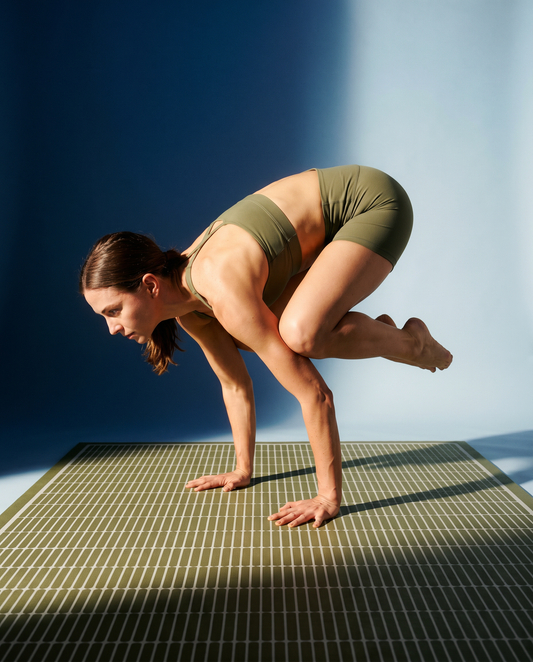
Quieter Swankymat palettes (Sloane Dust, Rhodes Camel, Sloane Forest) tend to disappear into a restorative space rather than draw the eye. For more on what to evaluate in a yoga mat that handles both active and recovery practice, the post on what makes a great yoga mat covers the considerations, and the post on a decorative yoga mat covers the design integration angle.