

The Barre Mat: Floor Work for Home Barre Practice

Barre has become one of the most popular fitness formats for adults who want strength, sculpting, and flexibility work without high impact. Home barre practice has grown substantially through Alo Moves, Pure Barre On Demand, Physique 57, and other on-demand platforms. The barre itself (or a sturdy chair as a substitute) handles the standing work. The floor is where the other half of the class happens, and the floor surface tends to be the piece most home barre practitioners underinvest in.
This post covers what home barre actually requires from the floor, why the floor phase is often more demanding than the barre phase, and what to prioritize for a barre setup that lasts.
What Barre at Home Actually Looks Like
A typical barre class breaks roughly in half between standing work at the barre and floor-based sequences. The floor work targets glutes, core, and thighs through small isometric contractions and precision movements that require significant cushion and space.
The standing work happens at the barre or a substitute (a sturdy chair, a countertop). The transitions between standing and floor happen frequently, sometimes every 90 seconds. The mat has to serve both phases without repositioning.
What the Floor Phase Puts on the Mat
Barre floor work is deceptively demanding on the mat surface.
Extended kneeling positions. Kneeling glute work, quadruped sequences, and floor-based ab work all put weight on the knees for extended durations. Thin mats become uncomfortable within minutes.
Supine and prone sequences. Extended time on the back for core work and on the stomach for glute sequences. The spine, hip bones, and rib cage all need cushion during these positions.
Small precision movements. Barre uses tiny isometric contractions rather than large range-of-motion work. The mat surface has to stay perfectly stable during these micro-movements without shifting or bunching.
Frequent transitions. Standing to floor to standing to floor across the class. The mat needs to stay in place through the transitions without sliding on hardwood.
What the Standing Phase Puts on the Mat
The standing phase at the barre is often overlooked in mat selection, but it puts specific demands on the surface too.
Balance work. Single-leg work, releve holds, and extension work all require a firm enough surface for stable balance. Overly cushioned mats undermine balance stability.
Small lateral movement. Barre uses small side-to-side shifts and directional changes at the barre. The mat needs to stay in place under this repeated lateral force.
Grip during pulses. Small pulsing movements at the barre produce continuous foot pressure. The mat surface has to hold the foot without slipping and without creating hot spots.
What to Prioritize in a Barre Mat
Five criteria for a floor that supports the full barre class.
6mm of high-density supportive cushion. Enough for extended floor work without joint pain, dense enough to preserve stability during standing balance work.
Single-piece construction. No seams to catch during transitions or shift during floor work. Barre involves too much position changing for tile floors to work.
Non-slip underside. Stays in place through the standing work, the transitions, and the floor work. Barre puts continuous lateral force on the mat.
Waterproof, wipe-clean surface. Barre produces meaningful sweat during the sequenced sequences. Daily cleaning has to be a damp cloth.
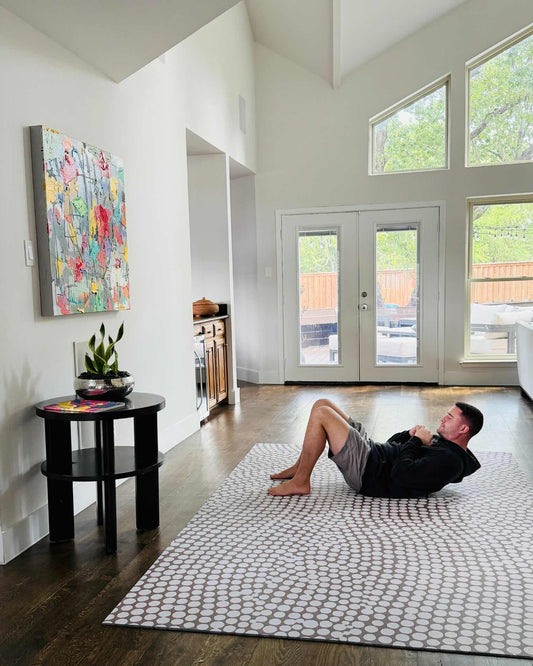
Adequate size for the full sequence. A standard yoga mat handles some barre floor work but often falls short during extended sequences that require lateral movement. 5 feet by 7 feet fits a solo home barre practice with adequate margin.
The Barre-Adjacent Formats
The same mat setup serves several barre-adjacent formats.
Pilates. Similar floor work demands, similar precision requirement. A mat that works for barre works for Pilates.
Sculpt and toning classes. The Nike Training Club, Alo Moves, and various on-demand sculpt formats use the same standing-plus-floor structure as barre.
Dance fitness with floor work. Dance-based fitness formats that include floor sequences use the same mat requirements.
The Swankymat Fit for Barre
Swankymat is built for the mixed standing-plus-floor practice that barre requires. Single-piece non-toxic high-density foam with 6mm of supportive cushion handles the extended kneeling and supine floor sequences without joint pain, and preserves the stability required for standing balance work at the barre. The non-slip underside stays in place through the standing-to-floor transitions that fill a typical class. The waterproof surface handles daily sweat and cleaning.
Available in Oversized 5x7 for solo barre practice, Oversized 6x9 for larger practice spaces or for anyone who wants extra margin for prop use, and the rollable Studio Mat for practitioners who travel to occasional studio classes.
For a related format specifically, the post on the best Pilates mat for home practice covers the overlapping requirements. For material feel before ordering, the swatch pack ships three real samples with $15 off the first Oversized mat.