

The Best Yoga Mat for Bad Knees: Cushion and Size That Actually Help

Knee pain is one of the most common reasons adults abandon a yoga or floor-based fitness practice within the first few months. The issue is rarely the practice itself. It is the surface under the practice. A thin mat exposes the kneecap during hands-and-knees work, low lunge, quadruped sequences, and any position that puts body weight on the joint. Within a few sessions, the practitioner starts avoiding kneeling positions. Within a few weeks, the practice becomes fragmented. Within a few months, it stops.
The good news is that this is one of the most solvable problems in the home fitness setup. The right mat cushion, density, and size make kneeling work comfortable, which makes the practice sustainable, which is what produces the actual results.
This post is general fitness information, not medical advice. For persistent knee pain or a diagnosed knee condition, consult a physical therapist or physician before adjusting your practice.
What Actually Hurts the Knee During Floor Work
Three specific pressure patterns account for most knee discomfort during yoga and floor-based fitness.
Direct kneecap contact. Any hands-and-knees position (tabletop, cat-cow, bird dog, quadruped variations) puts body weight directly on the patella. A thin mat provides inadequate cushion, and the kneecap grinds against the hard floor underneath.
Sustained pressure during held poses. Low lunge, half pigeon, gate pose, and other extended kneeling positions concentrate weight on the same spot on the knee for one to three minutes. Even mild inadequate cushion becomes painful over sustained duration.
Bone-on-floor contact during side positions. Side plank from the knee, kneeling side stretches, and modifications that use the knee as a base point all load the outer or inner knee against the floor.
What Cushion Actually Solves Each Pattern
Different pressure patterns need different mat responses.
For direct kneecap contact: 6mm of high-density supportive foam distributes the weight across a larger contact area rather than concentrating it on the patella. The kneecap sinks slightly into the cushion, which spreads the load and eliminates the point-pressure grinding.
For sustained pressure: The density matters as much as the thickness. Low-density foam compresses under the sustained weight and becomes effectively thinner within seconds. High-density foam holds its shape and continues to distribute weight throughout the held pose.
For side-position bone contact: Both thickness and mat width matter. The mat has to be cushioned enough to protect the outer knee, and wide enough that the knee stays on the mat during the position (not slipped onto the hard floor at the edge).
What Most Yoga Mats Get Wrong for Knee-Sensitive Practitioners
Three common configurations that fail knee-sensitive practitioners.
Standard 3-5mm yoga mats. Optimized for standing poses and grip. Adequate cushion is not a design priority. Most practitioners with knee pain need something thicker than what standard yoga mats provide.
Very soft (10-20mm) low-density mats. Cushioned but unstable. The foam compresses under the knee and creates an uneven surface that can actually increase discomfort. Standing balance becomes harder, and the practice compromises stability for cushion.
Standard 24-inch-wide yoga mats. Even with adequate cushion, the standard yoga mat width leaves the knee off the mat during any lateral kneeling position (kneeling side stretch, gate pose, kneeling twists). The knee lands on hardwood at the mat's edge.
What to Prioritize for Knee-Sensitive Practice
Five criteria for a mat that reliably supports knee-sensitive home practice.
6mm of high-density supportive foam. The practical sweet spot. Enough cushion to distribute weight without becoming so soft that stability suffers.
Density that holds shape under sustained weight. The mat should not compress and stay compressed during a two-minute held pose. High-density construction rebounds and continues providing support.
Adequate width for lateral kneeling positions. A 5-foot-by-7-foot or larger mat keeps the knee on the mat during any position, including wide-legged kneeling and side variations.
Single-piece construction. Interlocking tiles have seams that catch the knee and produce uncomfortable pressure points. A continuous single-piece mat eliminates the seam risk entirely.
Non-slip underside. The mat has to stay in place during kneeling transitions. A migrating mat forces the knee to constantly reposition, which is itself an aggravating pattern.
The Swankymat Fit for Knee-Sensitive Practitioners
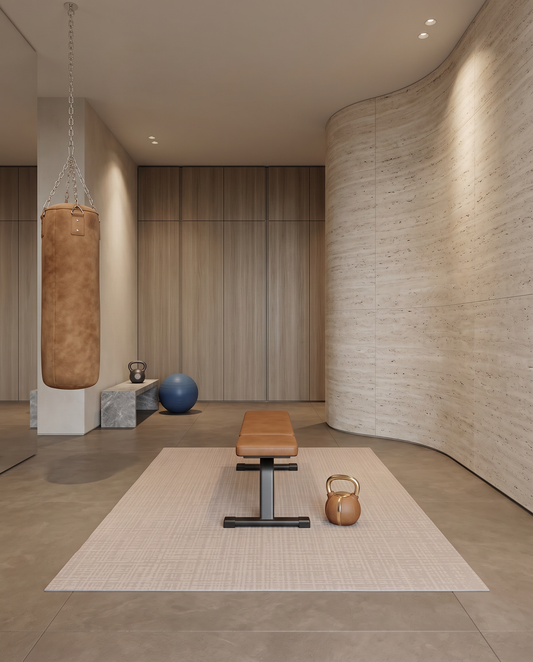
Swankymat is calibrated for the exact requirements of knee-sensitive home practice. Single-piece non-toxic high-density foam with 6mm of supportive cushion distributes weight across the kneecap without compressing under sustained pressure. The density holds shape through extended held poses. Available in Oversized 5x7 and 6x9 sizes that accommodate lateral kneeling positions without the knee slipping off the mat's edge, and the rollable Studio Mat in a smaller traditional footprint.
The waterproof surface handles daily use and cleaning. The non-slip underside stays in place during kneeling transitions on hardwood, tile, or laminate. The construction avoids the failure modes (peeling, delamination) that shorten most cushioned-mat lifespans.
The HSA/FSA Angle for Documented Knee Conditions
For practitioners with a diagnosed knee condition (chronic pain, post-surgical recovery, arthritis, meniscus issues, patellofemoral pain), the mat purchase often qualifies for HSA or FSA reimbursement when a licensed provider documents medical necessity. Swankymat partners with TrueMed to provide the Letter of Medical Necessity through a licensed medical provider. Customers using HSA or FSA funds save an average of 30 percent on the qualifying purchase amount.
The Confidence Path to the Right Mat
For anyone whose practice has been limited by knee discomfort, two low-risk starting points work well.
The Perfect Match Quiz takes 60 seconds and recommends a colorway and size based on your practice and space. Free.
The swatch pack ships three real material samples for $15, credited to your mat. Feeling the cushion density in hand is the reliable way to evaluate whether the mat will actually solve the knee-comfort problem. Ordering swatches first unlocks the Perfect Match Guarantee: if the colorway is not right once your mat arrives, you switch the mat for a different colorway one time, free. Swatch it, switch it free.
The Swankymat Promise
Every Swankymat is backed by four commitments. Built to Last, Backed for a Year (a 1-year quality guarantee on manufacturing defects and premature wear). Easy 30-Day Returns (live with your mat and if it is not right, send it back within 30 days). Spills Happen (waterproof and wipe-clean, so real life wipes right off). Perfect Match Guarantee (for anyone who orders a swatch pack first). Free shipping on all orders in the Continental US, including HSA/FSA orders through TrueMed.