

The Kettlebell Floor: What Kettlebell Training Requires From the Surface

Kettlebells have become one of the most popular home strength tools for good reason: a single kettlebell or pair can produce full-body strength, cardiovascular conditioning, and functional movement patterns across dozens of exercises. The compact footprint fits any home. The learning curve is steeper than dumbbells but the ceiling is meaningfully higher.
The setup problem: kettlebells put demands on the floor that neither yoga mats nor standard exercise mats handle well. Understanding what the surface actually needs to do changes the training experience significantly.
What Kettlebell Training Puts on the Floor
Kettlebell work loads a mat in four ways that combine to defeat most of the category.
Heavy point loads at rest. A parked kettlebell concentrates 30 to 70 pounds on a small base. Foam that cannot handle the point load develops permanent indentations within weeks.
Dynamic swing arcs. The swing pattern moves a heavy weight through a wide arc past the mat surface. Any interference (uneven mat surface, edge lift) creates a safety issue.
Occasional drops. Even experienced practitioners drop kettlebells occasionally. The Turkish get-up, the snatch, and the clean all have failure modes that put a heavy weight on the mat from height.
Lateral footwork during ballistic work. Cleans, snatches, and swings involve foot repositioning under load. The mat has to stay in place through the lateral force.
Why Most Mats Fail Kettlebell Work
Three specific failure modes come up consistently in kettlebell setups.
Permanent compression from parked bells. Lower-density foam under a resting kettlebell develops indentations that never recover. The mat becomes progressively worse in the primary training zones.
Migration during ballistic work. Underside grip fails under the lateral force of swings and cleans. The mat slides during high-force movements, which is a safety issue with a heavy weight involved.
Impact damage from drops. Thinner mats do not distribute the impact of a dropped kettlebell, which transfers to the floor underneath (dents on hardwood, cracked tile) and often damages the mat itself.
What Actually Works for Kettlebell Training
Five specifications for a floor that supports serious kettlebell work.
High-density construction that resists permanent compression. The bell has to rest between sets without deforming the surface.
6mm of supportive cushion. Enough to distribute point loads and absorb the occasional drop, dense enough to preserve stability during dynamic work.
Single-piece build with no bonded top layer. Impact from a dropped kettlebell will find any seam and separate it. Single-piece construction eliminates the seam entirely.
Non-slip underside that holds under lateral force. The mat has to stay in place during swings, cleans, and snatches at full power.
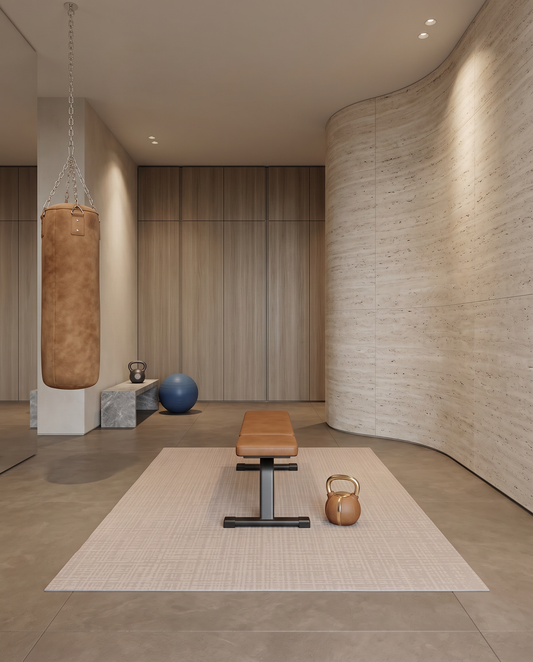
Adequate size for the full swing arc plus footwork. A kettlebell swing requires more space than a standard yoga mat provides. The bell arcs forward and back, the feet need lateral room, and the follow-through takes floor space beyond the standing position. 6 feet by 9 feet is the reliable size for kettlebell work.
The Common Kettlebell Setups
Three configurations that cover most home kettlebell training.
The single-bell setup. One kettlebell (typically 16, 20, or 24 kg) for full-body work. The most compact configuration. Requires the same floor specifications as heavier setups since the movement patterns matter more than the load.
The paired setup. A matched pair of kettlebells for double-bell work (double cleans, double front squats, double swings). Requires more floor space than the single-bell setup for the wider stance and swing arc.
The ladder setup. Three or four kettlebells of increasing weight for progressive work or for household members of different training levels. Requires storage space plus training footprint.
The Sound Consideration
Kettlebell training is noisy. The clank of the bell against the platform, the impact of ballistic work, and the occasional drop all produce sound that transfers to floors below. In apartments, the noise consideration is often the primary reason to use a proper cushioned mat.
A 6mm high-density foam mat under the kettlebell zone meaningfully reduces the sound and vibration transmission. It does not eliminate it, but it usually brings kettlebell training below the complaint threshold in most buildings.
The Swankymat Fit for Kettlebell Training
Swankymat handles the demands of kettlebell training that most mats do not. Single-piece non-toxic high-density foam construction resists permanent compression under parked kettlebells and eliminates the seam that impact would exploit in layered mats. The 6mm supportive cushion absorbs occasional drops and distributes point loads. The non-slip underside stays in place under the lateral force of swings and cleans. The waterproof surface handles the sweat volume of ballistic work.
The Oversized 6x9 is the size that fits the kettlebell swing arc plus footwork plus setup space for a paired or ladder configuration. The Oversized 5x7 works for single-bell setups in tighter spaces. For material feel and impact response before ordering, the swatch pack ships three real samples with $15 off the first Oversized mat.
For the broader home strength setup, the post on carving out a home wellness space covers layout considerations for equipment-based training.