Mat Pilates for the Reformer Client: What Changes at Home

If your Pilates lives on a reformer at a studio, and you have been curious about what mat work at home actually offers, the honest answer is that mat Pilates is a different form of the same principles. The springs are gone. The foot bar is gone. The moving carriage is gone. What is left is your body against gravity on a surface, which is the oldest form Joseph Pilates ever taught and the form he built the rest of the equipment out of.
Understanding what changes when the reformer is gone is how a reformer client gets a mat routine that actually feels like Pilates at home instead of feeling like a workaround.
What the reformer was doing for you
Three things the reformer provides that a mat does not, all worth naming so you can replace them thoughtfully.
Assisted resistance. The springs make hard movements easier for beginners and easier movements harder for advanced clients. The same exercise can be scaled up or down without swapping equipment.
Alignment scaffolding. The straps, foot bar, and headrest keep the body in a specific position so the intended muscles do the work. On the mat, the body has to organize itself without those anchors.
Novelty and load variety. A reformer session hits different plane angles and movement patterns in one hour than a mat routine can in the same time. Studios build class flow around that variety.
What mat Pilates gives you back
The trade is not one-sided. Mat work rewards a reformer client in ways the reformer does not.
Deeper core control. Without the springs assisting, the core has to stabilize on its own. Most reformer clients who add a mat routine report noticing their deep abdominal engagement improve within a few weeks.
Better proprioception. Feeling the ribs against the floor, the pelvis against the mat, the shoulder blades against the surface, gives the body clearer feedback about where it actually is. That translates back to the reformer as sharper form.
The rest of the week. A studio reformer session is once or twice a week. A mat routine can happen four or five times. Consistency does more for movement quality than session intensity.
How the classic mat exercises translate
The Hundred. Same on the mat as on the reformer. The absence of the straps means the arms do more stabilization work. Keep the pulse small and controlled.
Roll-up. Harder on the mat than on the reformer, where the foot bar assists. Bend the knees slightly if the full extension is not accessible yet. This is not a weakness, it is the mat asking for what it needs.
Single-leg stretch, double-leg stretch, criss-cross. The classic series translates directly. Focus on the ribs staying anchored and the pelvis staying stable.
Teaser. The reformer version uses the strap for balance. The mat version is a genuine test of core strength. Build it over months, not weeks.
Side-lying series. Translates directly. A cushioned surface makes the hip bone side of the exercise significantly kinder than a thin mat on a hard floor.
Swimming, single-leg kick, double-leg kick. Prone work is where a wider, thicker mat matters most. Rib and hip bones need cushion or the exercise gets cut short.
What to add if you miss the reformer resistance
Small equipment fills most of the gap without turning the room into a studio.
A magic circle. Twelve to fifteen inches, foam-padded. Adds resistance to inner thigh, outer thigh, and upper body work in a way that mimics spring feedback.
A pair of light hand weights. One to three pounds. Useful for the standing warm-up and for adding load to the standard mat series.
A resistance band. Loop or long, medium tension. Replaces some of the spring resistance for leg work and arm work.
None of this replaces the reformer. All of it makes the mat routine feel more like the studio session it is meant to complement.
What the mat itself has to do
A standard travel yoga mat is not enough surface for a mat Pilates routine. Two reasons.
Pilates works the spine, ribs, and hips against the surface. A twenty-four-inch-wide yoga mat is narrower than most torsos in prone or supine work. Elbows, hip bones, and rib cages end up off the mat and on the bare floor.
Cushion matters more in mat Pilates than in yoga. Yoga holds shapes. Pilates presses bones into the surface repeatedly. Prone kicks, side-lying series, and rolling exercises all put concentrated pressure on hip bones, ribs, and the tailbone. A thin mat cuts a session short.
What actually holds up is a wider, thicker cushioned mat that stays out between sessions. Wider than a yoga mat, thicker than a travel mat, and single-piece so seams and puzzle-tile gaps do not sit under the spine.
Where Swankymat fits in a home Pilates setup
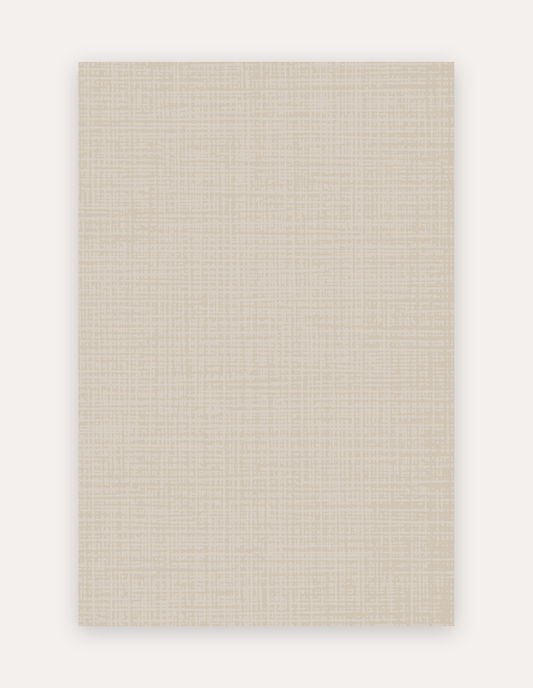
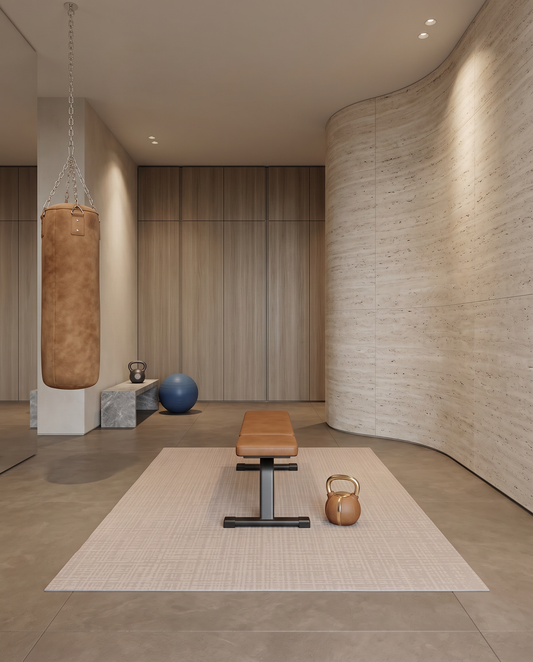
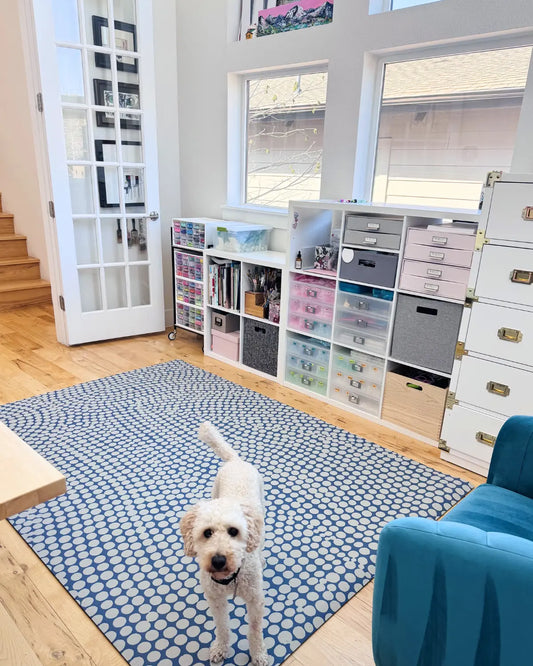
Swankymat is built on non-toxic high-density foam with a supportive cushion under ribs, hip bones, and the tailbone. Single-piece construction with no bonded top layer, so no seams to peel and nothing to trap sweat. Waterproof and wipe-clean, so a spilled water bottle wipes off with a damp cloth and mild soap. Hand-drawn patterned designs in restrained residential palettes, so the mat reads as a floor covering that belongs in the room rather than as gym gear rolled out for the session.
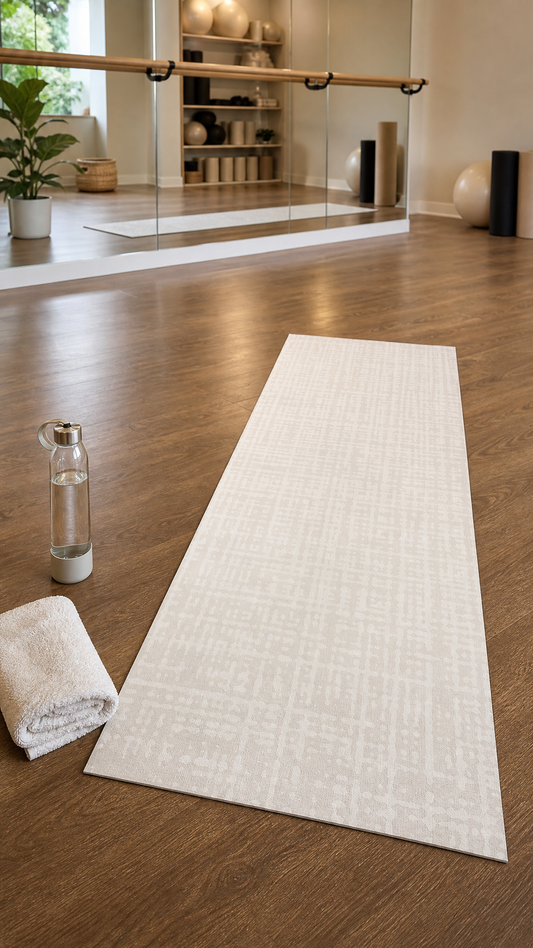
Available in Oversized 5x7 (60 by 84 inches) for a defined Pilates zone with room for the full mat series, Oversized 6x9 (72 by 108 inches) for a larger space or a shared setup, and the rollable Studio Mat (26 by 71 inches) at studio width and length for anyone who wants a portable option that stows away between sessions.
The Confidence Path to the Right Mat
Two low-risk starting points work well for anyone weighing the decision.
The Perfect Match Quiz takes sixty seconds and recommends a colorway and size based on the room and how it will be used. Free.
The swatch pack ships three real material samples for $15, credited to your mat. Feeling the samples under a hip bone or an elbow is the reliable way to confirm the cushion before ordering the full mat. Ordering swatches first unlocks the No-Sweat Guarantee. If you don't love your mat when it arrives, switch it within seven days, completely free. Swankymat pays return shipping. Swatch it, switch it free.
The Swankymat Promise
Every Swankymat is backed by four commitments. Built to Last, Backed for a Year, a one-year quality guarantee on manufacturing defects and premature wear. Easy 30-Day Returns, so you can live with your mat and send it back within thirty days if it is not right. Spills Happen, waterproof and wipe-clean, so real life wipes right off. No-Sweat Guarantee, for anyone who orders a swatch pack first. Free shipping on all orders in the Continental US, including HSA and FSA orders through TrueMed.