

A Beginner Core Workout You Can Do on the Floor at Home

Core work has an image problem. Say the words and most people picture endless crunches and a burning neck, which is exactly the kind of workout nobody looks forward to. But a strong core is about far more than visible abs. It's what keeps your posture upright, protects your lower back, and makes everyday movements, lifting, twisting, carrying, reaching, feel easier and safer. The good news is that a genuinely effective beginner core routine needs no equipment, takes about ten minutes, and happens entirely on the floor. Here's how to start.
What your core actually is
Your core is more than the muscles you see. It's the whole cylinder of muscle around your midsection, the abs in front, the obliques on the sides, the deep stabilizing muscles underneath, and the muscles of your lower back. They work together to stabilize your spine and transfer force between your upper and lower body. That's why core training that focuses on stability, holding a strong position against movement, tends to be more useful for everyday life than endless crunching. It's also gentler on your back, which matters for beginners.
A simple beginner core routine
Move through these slowly and with control. Quality matters far more than speed or numbers:
- Dead bug. Lie on your back, arms reaching up, knees bent at 90 degrees. Slowly lower the opposite arm and leg, then return. It teaches your core to stay stable while your limbs move, which is the whole point.
- Glute bridge. Feet flat, lift your hips until your body forms a straight line, squeeze, and lower slowly. It strengthens the back of the core and the glutes that support your spine.
- Bird-dog. On all fours, extend the opposite arm and leg, hold briefly, and switch. Excellent for balance and the deep stabilizers.
- Modified plank. Hold a straight line from knees or toes, bracing your middle. Start with short holds and build up. A solid plank beats a hundred sloppy crunches.
- Heel taps. Lying down with knees bent, gently tap one heel to the floor at a time while keeping your lower back stable. Small movement, real work.
Aim for two or three rounds, resting as needed. Two or three sessions a week is plenty to start, and your core recovers quickly, so it tolerates frequent, gentle work.
How to do it safely
Form is everything with core work, because sloppy technique shifts the effort to your neck and lower back. Keep these in mind: don't yank on your neck, let your head rest heavy in your hands or keep your gaze up. Breathe steadily rather than holding your breath. Keep the movements slow and controlled, since momentum cheats the muscle you're trying to train. And stop any movement that causes lower-back pain, switching to a gentler variation instead. The goal is to feel the work in your middle, not your neck or spine.
Common beginner mistakes
The biggest one is chasing high reps before you've built control, which usually just trains bad form. Another is rushing, since core exercises done fast look productive but do far less than slow, deliberate reps. Many beginners also forget the back half of the core entirely, hammering the front with crunches while ignoring the glutes, lower back, and deep stabilizers that actually protect the spine. And plenty of people quit early simply because grinding their tailbone and spine into a hard floor is uncomfortable, which brings us to the part of the setup most people overlook.
Why the floor matters more than you think
Core work means lying down, rolling, bridging, and pressing your spine and tailbone into the floor over and over. On bare hardwood or tile, that's genuinely painful, and the discomfort, not a lack of motivation, is often why people abandon their core routine within a week. A thin yoga mat helps a little but not enough for the bony contact points. A towel slides out from under you mid-movement. If the surface makes the exercises hurt in the wrong places, you won't keep doing them, and core strength only comes from consistency.
A surface that keeps core day comfortable
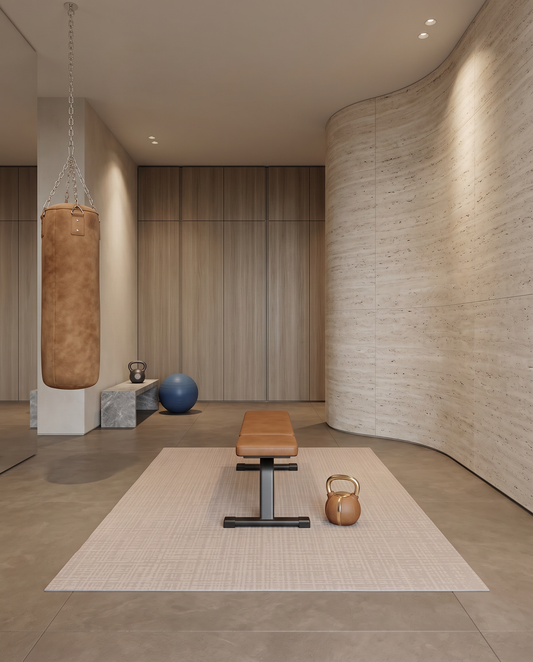
This is exactly where a Swankymat earns its place in a home routine. The 6mm cushion protects your spine, tailbone, and hips through bridges, dead bugs, and heel taps, so the discomfort that ends most core routines simply isn't there. It's large and stable, so you can move through every position without sliding or running off the edge, and it's made with non-toxic materials and Greenguard Gold certified inks. Because it's waterproof and wipe-clean, the sweat of a real session isn't a problem, and because it looks good enough to leave out, the mat stays visible and ready, which is the quiet nudge that keeps a new habit alive. And since it's HSA/FSA eligible, the surface that makes core work comfortable may even qualify for tax-advantaged dollars. A strong core is built a few minutes at a time, and a floor that doesn't fight you is what makes those minutes happen.