

What Is the Best Mat for Yoga and HIIT at Home?
What Is the Best Mat for Yoga and HIIT at Home?
The best mat for yoga and HIIT at home is a single large, non-toxic surface with reliable grip, adequate cushioning, and enough space to move freely through both disciplines without adjusting your setup between them. That answer sounds simple but getting there requires understanding why most mats fall short of it and what specifically to look for in one that does not.
If you practice yoga and do high intensity interval training at home, you have probably noticed that your current mat situation is a compromise. Your yoga mat is the right thickness for poses and flows but too narrow and too thin for jump landings, lateral movements, and the dynamic full-body work that HIIT involves. Your exercise mat handles the impact reasonably well but feels too firm and too expansive for the focused, precise movements of a yoga practice. Most people with a dual-discipline home routine end up owning both and being fully satisfied by neither.
The assumption driving that compromise is that yoga and HIIT are too different to share a surface. That assumption is worth examining carefully, because the right home exercise mat resolves the tension between them more completely than most people expect. If you are looking for a broader recommendation for general home fitness use, this guide to the best play mat for home fitness covers that territory well. But if your routine specifically combines yoga and high intensity training, the dual-discipline question has a more specific answer that is worth working through carefully.
Why Yoga and HIIT Feel Like They Need Different Mats
The surface requirements of yoga and HIIT pull in genuinely different directions, which is why the two-mat instinct is understandable even if it is ultimately unnecessary.
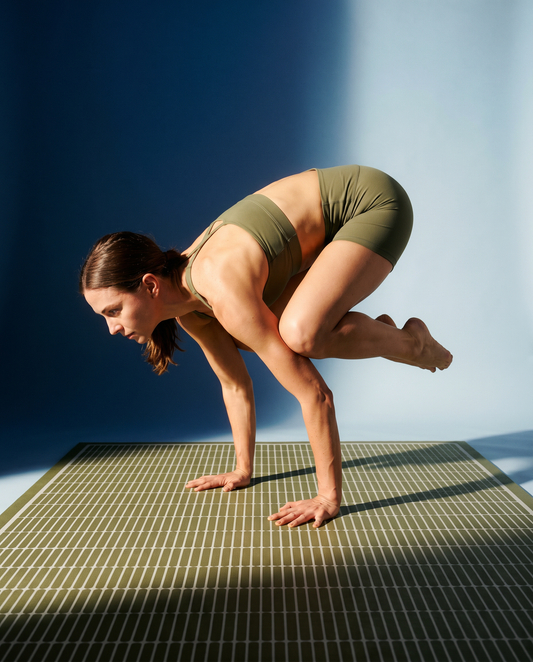
Yoga prioritizes grip, precision, and a surface that keeps you stable through static holds and slow transitions. The contact points during a yoga practice are specific and intentional — hands, feet, knees, forearms — and the mat needs to provide enough traction at each of those points to support balance and alignment without sliding. Thickness matters less than surface texture and grip quality for most yoga practitioners, which is why standard yoga mats tend to be relatively thin and narrow. They are optimized for a specific set of movements that happen in a defined, predictable space.
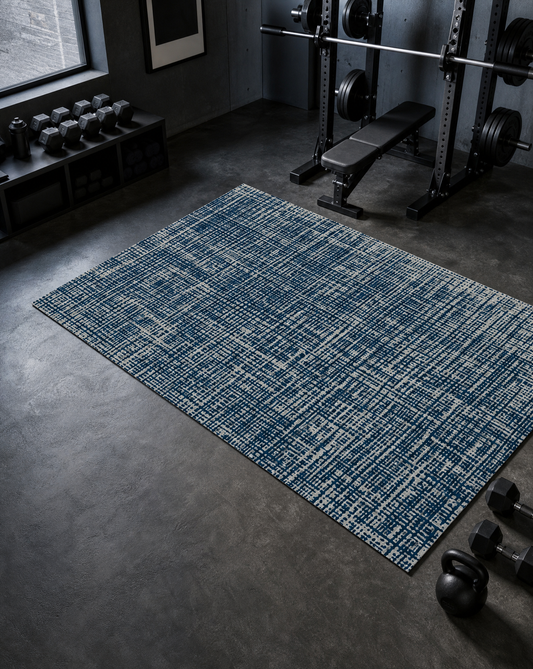
HIIT prioritizes cushioning, surface area, and a mat that absorbs impact and accommodates rapid directional changes. Jump landings, burpees, lateral shuffles, and floor-to-standing transitions all require more room and more shock absorption than a yoga practice does. A mat that is too thin makes HIIT uncomfortable and harder on joints over time. A mat that is too small turns every dynamic movement into a spatial negotiation that interrupts the flow of the workout and creates a low-grade frustration that compounds across every session.
The tension between these two sets of requirements is real. But it is resolvable, and understanding exactly where it lies makes it much easier to identify the home exercise mat that handles both without meaningful compromise.
What the Best Yoga and HIIT Mat Actually Needs to Do
A dual use exercise mat that genuinely works for both yoga and HIIT needs to satisfy five criteria simultaneously. Most mats satisfy two or three of them. The right one satisfies all five.
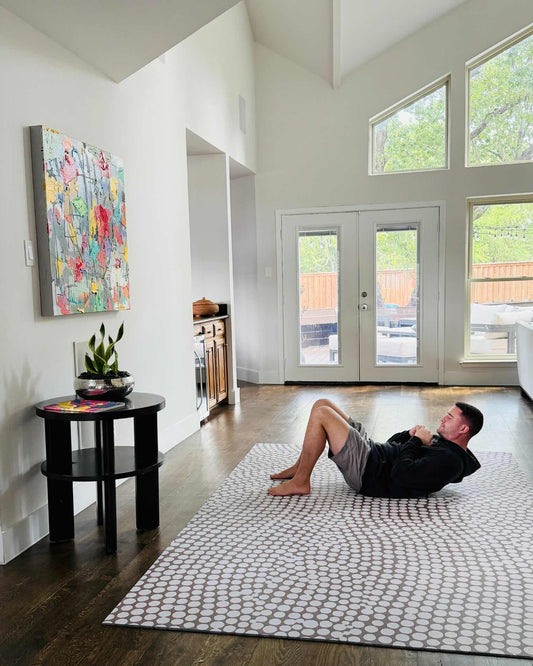
Size is the first and most non-negotiable criterion. A standard yoga mat at 68 by 24 inches is too small for HIIT. A standard exercise mat may be large enough for dynamic movement but can feel disorienting for yoga flows that require precise spatial awareness and a clearly defined practice boundary. A mat of at least 5x7 feet gives you enough surface area for the full range of HIIT movement while remaining oriented enough for yoga practice without feeling like you are working on a gymnasium floor. At 6x9 feet the size constraint disappears entirely for both disciplines and the mat becomes a permanent movement zone within your home rather than a piece of equipment you manage around.
Grip is the second criterion and the one that most directly determines yoga practice quality on a surface that also needs to handle HIIT. The surface needs enough traction to keep hands and feet stable during held poses and slow flows, while also being firm and consistent enough underfoot for the standing and jumping movements of high intensity training. A surface that is too slippery undermines yoga. A surface that is too aggressively textured creates drag and discomfort during dynamic HIIT movements. The right balance is a surface that grips when you need it to and releases cleanly when you move.
Cushioning needs to sit in a specific middle range. Too thin and jump landings become joint issues that accumulate over time. Too soft and the surface compresses unpredictably during standing yoga poses and creates instability during HIIT movements that require a firm, consistent base. A mat in the right thickness range for dual use feels supportive underfoot without feeling spongy — stable enough for yoga balance work, forgiving enough for the impact demands of high intensity training.
Cleanability matters more for a dual use mat than for a single discipline surface because it is absorbing sweat from two different types of physical activity. A yoga practice generates sustained sweat across a defined surface area. HIIT generates sweat across the entire mat as the body moves through its full range. A wipe-clean waterproof surface handles both without absorbing odor, bacteria, or residue into the material. A mat that absorbs sweat from daily dual discipline use becomes unhygienic faster than the timeline most people anticipate and harder to clean thoroughly enough to stay genuinely clean at floor level where your face, hands, and body make direct contact.
Material safety is the fifth criterion and the one most directly relevant to a surface used daily with prolonged skin contact. A home exercise mat used every morning for yoga and HIIT is a surface your body is pressed against, breathing close to, and sweating onto for an extended period each day. It should be explicitly free from phthalates, BPA, and flame retardants — the three chemical categories that raise the most legitimate safety concerns for daily contact surfaces. As this breakdown of what makes a non-toxic exercise mat worth buying explains, material safety is worth treating as a baseline rather than a premium feature for any mat used this frequently and this closely.
The Case Against Two Mats
The two mat solution — a yoga mat for yoga, an exercise mat for HIIT — sounds reasonable and turns out to be more inconvenient than most people anticipate before they live with it.
The practical friction starts immediately. Switching between mats means rolling one up and rolling the other out at the transition point between disciplines, which interrupts the flow of a combined session and creates a small but consistent barrier between the warm-up yoga portion of a workout and the high intensity portion that follows. Over time that friction is enough to make most people default to one discipline or the other rather than combining them as intended.
Storage is the second problem. Two mats of any meaningful size take up significant space in a home that is not a dedicated gym. They lean against walls, occupy corners, and create the low-grade visual clutter of fitness equipment that never quite gets put away properly because putting it away properly would mean not having it accessible enough to actually use.
The cleaner solution is one mat large enough and well-constructed enough to handle both disciplines without compromise. A single surface that stays out permanently, requires no setup or transition, and handles the full range of what you do on the floor at home is a meaningfully better experience than two mats that each do their job adequately but together create more friction than they resolve. This is the same conclusion that most home practitioners who have tried both approaches reach eventually, and it is covered in more depth in this comparison of yoga mats and exercise mats for home use.
What to Look for in Practice: Evaluating a Dual Use Mat
When you are evaluating a specific mat for yoga and HIIT dual use, here are the practical questions worth asking before you buy.
Is it large enough to complete a full HIIT session without stepping off the surface? If the answer requires you to mentally edit your workout to fit the mat, it is not large enough.
Does the surface grip reliably in a downward dog held for thirty seconds? Grip that holds for the first few seconds but degrades with light sweat is not adequate for a yoga practice that generates sustained warmth and perspiration.
Can you do a jump squat series on it without the mat shifting on your floor? A mat that migrates during HIIT is a safety issue as well as a practical annoyance. The underside grip matters as much as the surface grip for dynamic use.
Is the cushioning firm enough that a warrior three balance pose feels stable? If you can feel the floor compressing unevenly beneath your standing foot during a balance pose, the mat is too soft for yoga use regardless of how well it handles impact.
Can you wipe it down completely in under two minutes after a combined session? If the answer is no, the daily cleaning routine will eventually become a barrier to using it as frequently as you intend.
Finding the Right Mat
Swankymat's extra-large mats are designed for exactly this kind of daily dual discipline use. Available in 5x7 and 6x9 sizes, free from phthalates, BPA, and flame retardants, with a wipe-clean waterproof surface and enough grip to stay stable on hardwood and tile through both yoga flows and high intensity training, they are built to be the one home exercise mat that removes the need to choose between disciplines or manage multiple surfaces. If you prefer a class-style mat that rolls up between sessions, our best-selling studio mats bring the same construction to a studio footprint. You can explore the full range here.