Best Yoga Mat for Beginners in 2026

The first yoga mat you buy is a quiet decision. You are not shopping for performance yet, you are shopping for a surface you will meet every morning, something that will sit in the corner of a room you live in and stay there for years. Most beginner mats are built for the opposite assumption, that this is temporary, portable, replaceable. Start there and the mat goes in a closet by month three.
The best yoga mat for beginners in 2026 is a cushioned, well-made, design-first floor piece large enough to move on without stepping off, and clean enough to live out between sessions. Not the one you can throw in a tote. The one that earns its place in the room so you never have to retrieve it to start.

Why most beginner yoga mat advice sends you to the wrong mat
The standard beginner recommendation is a thin, portable, inexpensive mat. The logic goes that you are not sure if you will stick with it, so you should not spend much. On paper that sounds sensible. In the home it quietly becomes the reason you quit.
A thin mat on a hard floor is painful for hands and knees within three weeks. A narrow mat limits what you can do before you are off the edge. A rolled-up mat tucked behind a chair is a mat you have to retrieve, unfurl, and flatten before every session, a small friction that compounds until the easier choice is to skip. The beginner who built a daily routine kept a mat out, in the room, ready. The beginner who stored a cheap mat to prove discipline usually never proved it.
Buying for the version of you who shows up every day costs less over the next three years than buying twice, which is what most beginners do.
What the first yoga mat really needs to do
A beginner mat has a specific job. It has to make the first thirty days inviting. Five things determine whether it does that:
- Cushion for repeated kneeling. Child's pose, tabletop, forearm plank, low lunge. Six millimeters of high-density foam is the floor. Anything thinner gets painful before you have built a routine.
- Enough width and length to not think about edges. Beginner yoga spends more time off-center than studio yoga does. A standard 24 by 68 inch mat means you are negotiating with the edge from week one.
- Grip you can trust in a downward dog held for twenty seconds. If the mat slides when your hand sweats, the pose breaks. If the mat slides on hardwood, the whole workout feels unsafe.
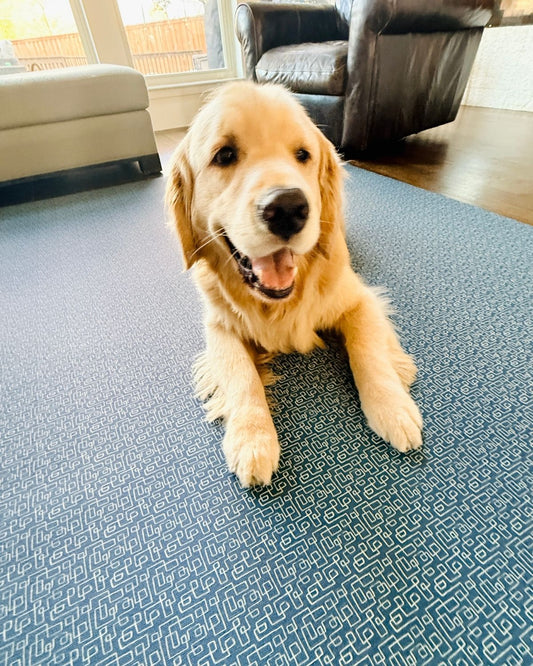
- A surface that wipes clean after every session. Sweat and dust on an absorbent mat become smell within two weeks. A wipe-clean waterproof surface stays clean enough to want to lay down on.
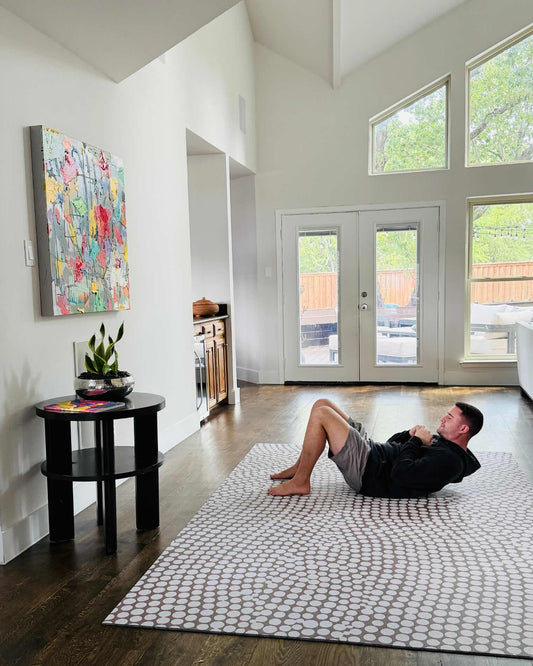
- A design you are glad to see in the room. The mat stays out. If it looks like gym equipment, you will move it. If it looks like it belongs, you will leave it and that is what keeps you coming back.
Thickness that matters for a beginner
Six millimeters is the honest answer. Thinner mats are marketed as giving you a closer connection to the floor, which is a studio argument that does not survive a home routine. On a wood or tile floor, 3mm to 5mm mats transfer every bony landing straight into the joint. Beginners feel this the fastest because their joints are not yet conditioned to the positions.
Thicker is not always better either. A mat over 8mm starts to compress unevenly under a standing balance pose, which trades joint cushion for instability in warrior three. Six millimeters is the range where cushion and stability meet, and it is the range the best mats for beginners should sit in. For a longer look at what six millimeters actually solves, this guide walks through the thickness math.
Size that removes friction from the first month
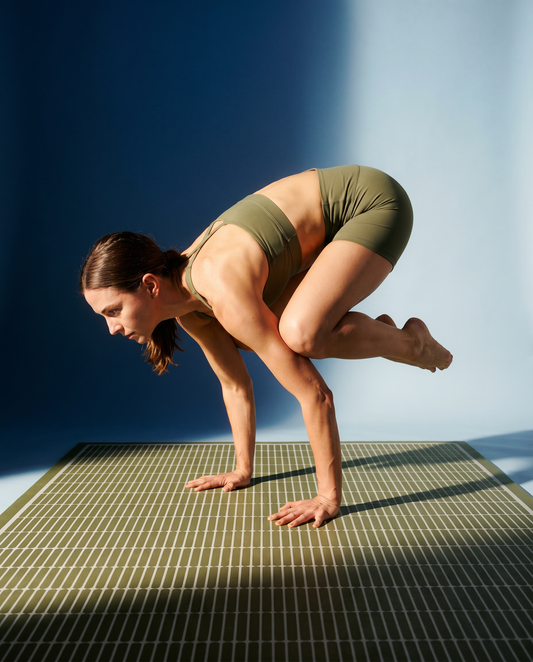
A beginner yoga routine moves more than people expect. Child's pose stretches forward, a lunge stretches back, lateral stretches go wide. On a standard narrow mat, all of this happens at the edge, which teaches you to shrink your movement to fit the mat. That is the opposite of what you want to learn.
A 5x7 or 6x9 mat removes the edge as a variable. You stop thinking about the mat and start thinking about the shape of your body. For a beginner that difference is the difference between a routine that compounds and one that stalls because every session feels slightly off. The 5x7 size is the right first format for most beginners, and 6x9 is the move when the room has the floor space to spare.
Material safety is baseline, not a premium feature
A yoga mat is a surface you breathe close to, press your face against, and sweat onto. For daily use the materials matter more than for a mat used twice a month at a studio. The three categories worth knowing about are phthalates, BPA, and flame retardants. A mat that does not explicitly state it is free of all three is a mat you should keep asking about. Non-toxic, high-density foam printed with Greenguard Gold certified inks is the honest baseline for something you touch every morning.
What a beginner yoga mat should not try to be
A few things get sold as beginner features that turn out to be the opposite.
Alignment lines printed on the surface look helpful in a studio setting and become visual noise in a home routine. You stop reading them by week two and are left with a mat that still looks like a class handout.
The cork-topped mat trend sells a natural look and tends to feel colder, firmer, and less forgiving than the foam underneath a beginner really needs. It is a studio mat positioning in a beginner conversation.
Travel-weight mats under three pounds are built to fold into a bag. The trade is cushion. For a daily home routine, the folding feature is a feature you will never use, and the cushion is the thing you will miss every session.
Where Swankymat fits in a beginner routine
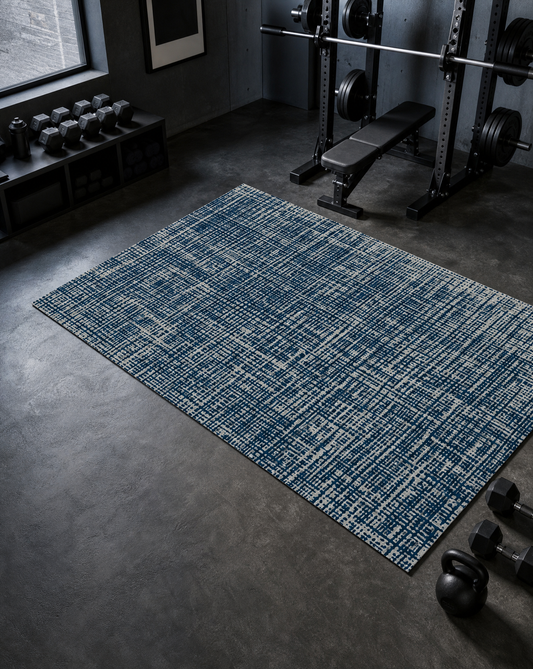
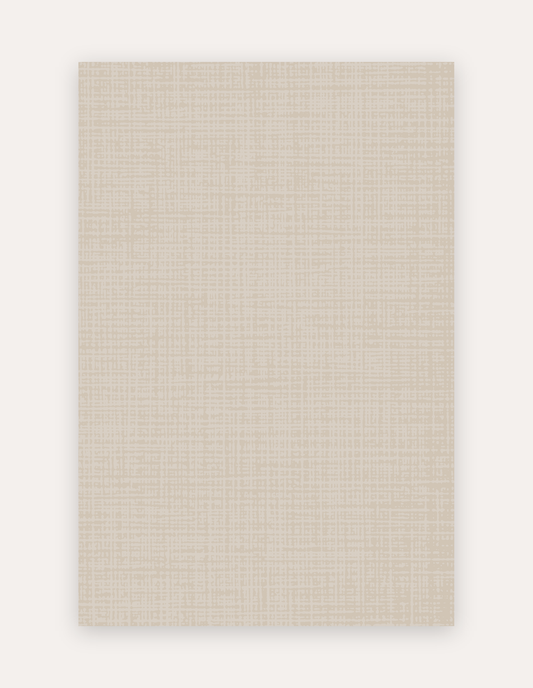
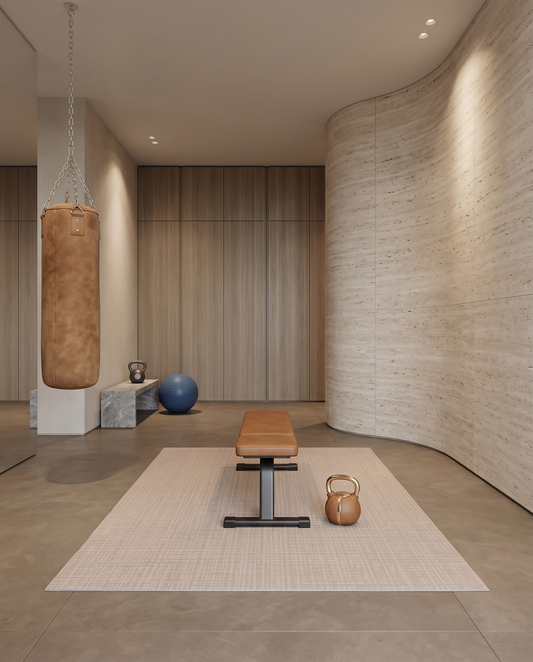
Swankymat built the Sloane Dust Oversized around the mat that gets a beginner through the first year. Six millimeters of supportive non-toxic high-density foam. One single piece in 5x7 or 6x9. A soft greige crosshatch pattern that reads as a woven textile, so the mat lives in the corner of a bedroom or living room without turning the space into a gym. Wipe-clean waterproof surface. Free of BPA, phthalates, and flame retardants. Greenguard Gold inks on the printed layer.
For the beginner who wants a traditional rollable yoga-shape mat because the class they are considering is 68 inches long, the Sloane Dust Studio Mat is the same material and the same pattern in a 26 by 71 inch rollable format. Either is the right first mat. Both get you to day 180.
The confidence path to the right mat
You do not have to guess at your first mat. Two paths make the decision low-stakes.
First, take the Perfect Match quiz. Four questions, matched to the colorway that fits your room and the size that fits your yoga. Second, order a Swatch Pack. Three physical material samples arrive in your mailbox and you see the color against your actual floor, not a screen. The swatch cost credits back to any mat purchase and it unlocks the No Sweat Guarantee, which means if the mat you ordered does not feel right in your room you can swap it or return it within seven days.
The Swankymat Promise
Non-toxic, high-density foam. Six millimeters of supportive cushion built for kneeling, standing, and everything your yoga routine asks a floor to do.
Design-first colorways. Patterns and tones that read like a rug in your home, not gym gear in your way.
Greenguard Gold inks. The printed layer is certified for low chemical emissions.
No Sweat Guarantee, for anyone who orders a swatch pack first. If the mat does not feel right when it arrives, swap it or send it back for a full refund within seven days, no sweat.