Best Play Mat for Home Fitness: 2026 Buyer's Guide
If you work out at home regularly, you have probably noticed that your floor situation is not quite working. A standard yoga mat is too narrow for anything involving lateral movement. A foam gym mat is thick enough to cushion jumps but too soft for stable strength work. A collection of interlocking tiles covers the floor but creates edges that catch your feet and gaps that collect everything you would rather not think about. Most home fitness setups involve a compromise between what works for the workout and what works for the space, and most people have quietly accepted that compromise as the price of exercising at home.
The best play mat for home fitness solves all of it in one surface. Large enough to move freely in any direction, stable enough for strength work, cushioned enough for floor-based recovery, and designed to stay out permanently without making your living room look like a gym. Here is what to look for when choosing one.
Why Your Current Mat Is Probably Holding You Back
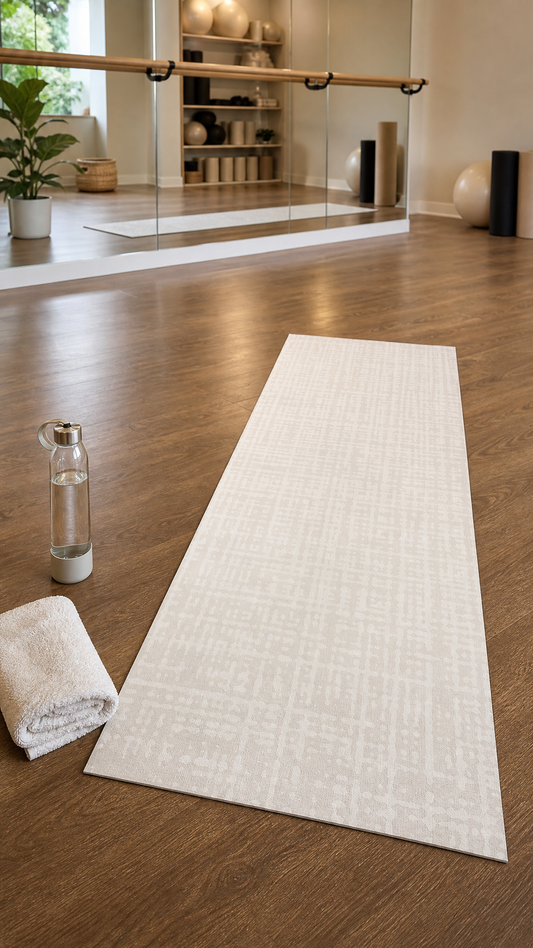
The average yoga mat measures 68 by 24 inches. That is enough space to stand with your feet together and extend your arms, and not much more. The moment your workout involves a lateral lunge, a burpee, a wide-legged stretch, or any movement that takes you off center, you are either stepping off the mat or constantly repositioning it. For a single-discipline practice like a seated meditation or a slow flow, a standard mat is adequate. For the kind of varied, dynamic movement that characterizes most home fitness routines, it is a persistent frustration.
The problem compounds when you are doing multiple things in one session. A yoga warm-up followed by bodyweight strength work followed by a cool-down stretch requires different amounts of space at different moments. On a standard mat, you are managing the mat as much as you are managing the workout. That friction is small enough that most people do not consciously identify it as a problem, but it is significant enough that it quietly discourages the kind of spontaneous, varied movement that makes home fitness sustainable long term. As this comparison of yoga mats versus exercise mats explains, the gap between what each surface is designed for and what most home practitioners actually do is wider than most people realize.
What to Look for in a Play Mat for Home Fitness
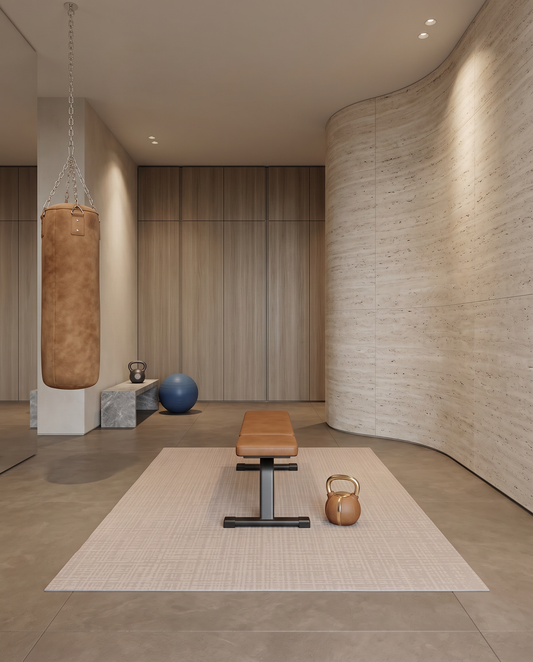
Size is the first and most important criterion. A play mat for home fitness should be large enough to accommodate your full range of movement without adjustment. For most adults that means a minimum of 5x7 feet, with 6x9 being the more practical choice for anyone whose routine includes dynamic or multi-directional movement. At that size the mat functions less like a piece of equipment and more like a dedicated movement zone within your home, which changes how you relate to your workouts in ways that are difficult to articulate until you experience it.
Grip is the second criterion and the one most people underestimate until they are sliding across their floor mid-movement. A play mat for home fitness needs to maintain traction on your floor surface without shifting, bunching, or requiring constant repositioning. The underside grip matters as much as the surface grip, particularly on hardwood and tile floors where standard mats tend to migrate during use.
Firmness and cushioning need to be in balance. A mat that is too soft compresses unpredictably during strength work and creates instability during standing movements. A mat that is too firm provides no meaningful cushioning for floor-based exercises, jump landings, or extended time on hands and knees. The right play mat for home fitness sits in the middle — firm enough to feel stable underfoot, cushioned enough to make floor work comfortable for extended sessions.
Cleanability is the criterion that separates a mat you will use for years from one you will quietly retire within months. A mat used daily for fitness accumulates sweat, dust, and the general residue of regular use. A wipe-clean, waterproof surface makes maintenance a thirty-second task rather than a production, which means you will actually do it.
The Case for One Large Mat Over Multiple Smaller Ones
The instinct when setting up a home fitness space is often to accumulate: a yoga mat here, a foam tile section there, a padded area for stretching in the corner. The result is a floor that looks improvised, requires constant rearranging, and never quite feels right for any single activity. Interlocking tiles in particular create a surface that looks temporary regardless of how long it has been there, and the edges and seams become tripping hazards and cleaning nightmares over time.
A single large play mat eliminates all of that. One surface, one cleaning routine, one intentional design choice that works for every type of movement you do at home. The psychological effect is also worth noting — a dedicated, well-designed movement surface signals to your brain that this is a space for exercise in a way that a rolled-out yoga mat on a hardwood floor does not. That signal matters more than most fitness advice acknowledges. As this guide to the best extra large mats for home workouts covers, the shift from multiple small surfaces to one large one is one of the more impactful and underrated changes you can make to a home fitness setup.
Non-Toxic Materials: Why They Matter for Daily Fitness Use
A play mat used for home fitness is a surface you are in close contact with every day. You are lying on it, sweating on it, pressing your face into it during push-ups and stretches, and breathing close to it during floor work. The materials it is made from matter in a way that a mat used occasionally at a gym studio does not.
The three chemicals worth specifically avoiding are phthalates, BPA, and flame retardants. Phthalates are plasticizers found in many foam and PVC products that have been linked to hormonal disruption with prolonged exposure. BPA is a chemical used in some plastics that raises similar concerns. Flame retardants are added to many foam fitness products and have been associated with health risks that become more significant with daily contact over time.
A mat that is explicitly free from all three is not a premium feature — it is a baseline standard for something you use every day at home. Look for specific chemical disclosures rather than general eco-friendly or natural language, which is common across the fitness mat category and does not necessarily mean anything specific about what the mat does or does not contain.
How a Great Fitness Mat Changes the Way You Use Your Space
The practical benefits of a well-chosen play mat for home fitness are straightforward: more room to move, better grip, easier cleaning, safer materials. But the less obvious benefit is what happens to your relationship with your home workout routine when the surface problem is solved.
When your mat is large enough to accommodate any movement, you stop editing your workout around your equipment. When it is designed well enough to stay out permanently, your workout space is always ready rather than something you have to set up and break down. When it doubles as a design element rather than an eyesore, you stop feeling the low-grade guilt of having gym equipment taking over your living room.
For households with children, the same surface that handles your morning workout handles tummy time, floor play, and the general chaos of daily life with kids. One mat, one surface, one solution for the full range of what happens on your floor at home. That versatility is what separates a play mat worth investing in from a collection of single-purpose fitness products that never quite add up to a satisfying whole.
Finding the Right Mat
Swankymat's extra-large mats are designed with exactly this use case in mind. Available in 5x7 and 6x9 sizes, free from phthalates, BPA, and flame retardants, with a wipe-clean surface and enough grip to stay stable on hardwood and tile, they function as a permanent home fitness surface that also happens to look intentional in your space. You can explore the full range at swankymat.com.