

What Your Home Workout Routine Actually Needs (It’s Not More Equipment)
Why home workout routines tend to fall off
Most home workout routines do not fail all at once. They taper off over time, often without much notice. What begins as a structured plan slowly becomes inconsistent, then occasional, and eventually something you stop thinking about altogether.
It is easy to assume this comes down to discipline or time, but more often the issue is less personal. The routine itself may be reasonable. The conditions around it are what make it difficult to maintain.
Working out at home removes the structure that naturally supports consistency. There is no transition into a separate space, no set rhythm, and no clear boundary between movement and everything else competing for attention. Each time you consider working out, you are also deciding whether it is the best use of that moment.
The impact of small barriers
That decision becomes harder when starting requires even a small amount of effort.
In many homes, working out involves a series of small steps. Space needs to be cleared. A mat is rolled out. Equipment is gathered and arranged. These steps are not difficult, but they interrupt the flow of the day.
Over time, those interruptions matter. They introduce just enough friction to make starting feel optional. And when something feels optional, it is easier to delay.
This is one of the main reasons routines that feel manageable in theory do not always hold up in practice.
Why adding more rarely helps
A common response is to try to strengthen the routine by adding more. More structure, more equipment, or more detailed plans.
In practice, this often makes things harder.
More equipment introduces more setup and more decisions. A more complex routine requires more effort to begin. What feels like progress can actually increase the distance between intention and action.
Instead of making movement easier, it creates more opportunities to put it off.
The role of your space
What tends to matter more than the routine itself is how your space supports it.
In a home setting, consistency is closely tied to accessibility. When movement can begin without preparation, it happens more often. When it requires a process, it becomes something that can be postponed.
This is why integrated spaces tend to work better than designated workout areas. A space that allows for movement within the natural flow of the day removes the need to shift into a separate mode.
If you are thinking about how to create a setup that fits into your home more naturally, this guide walks through it in a practical way.
Why the surface matters more than expected
The surface you use plays a larger role than most people expect.
A mat that needs to be taken out and put away each time reinforces the idea that working out is a separate activity. It creates a starting point that depends on preparation.
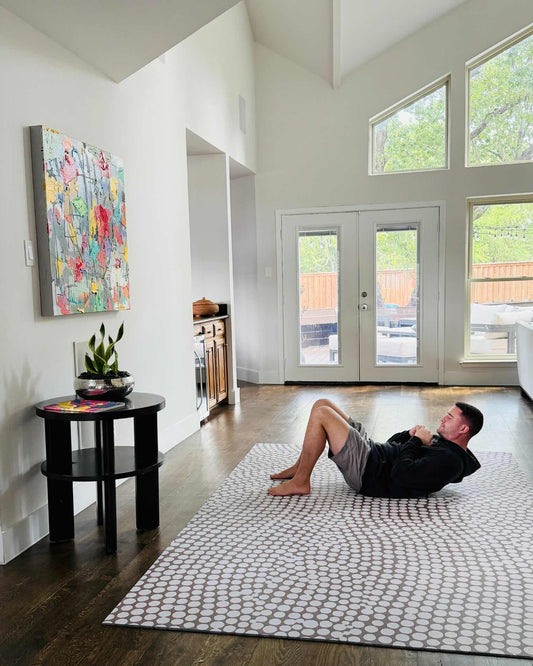
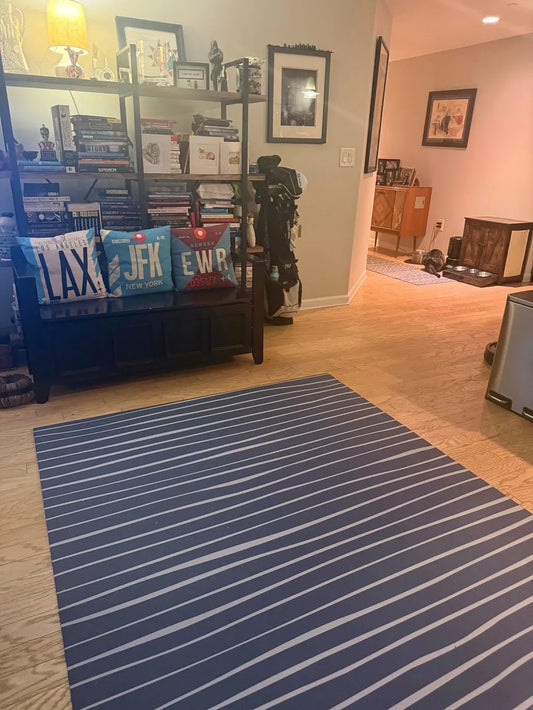
A surface that remains in place removes that step. It allows movement to begin without interruption, which changes how often it actually happens.
This becomes even more important in spaces that serve multiple purposes throughout the day. Instead of switching between setups, one surface can support movement, play, and everyday use without constant adjustment.
This idea is explored further here: (https://www.swankymat.com/blogs/blog/when-does-a-play-mat-make-sense)
Where traditional mats fall short at home
Standard yoga mats were designed for portability, not for living spaces.
In a home environment, their size can limit movement and require frequent repositioning. These interruptions are subtle, but they affect the overall experience of working out.
Over time, they contribute to the same friction that makes routines harder to maintain.
Larger surfaces reduce the need for adjustment and allow movement to feel more natural. This difference tends to become more noticeable with repeated use.
If you are comparing options, this article breaks down those limitations in more detail: (https://www.swankymat.com/blogs/blog/why-small-workout-mats-stop-working-at-home)
What actually makes a routine stick
Routines that last tend to have one thing in common. They do not rely on ideal conditions.
They fit into the reality of daily life. They allow for flexibility. They do not require a full reset of your space or your schedule in order to begin.
This is where simplicity becomes useful. Not as a way of doing less, but as a way of removing barriers.
When fewer steps stand between deciding to move and actually starting, consistency becomes easier to maintain.
A different way to approach your routine
If a home workout routine is not sticking, the most effective change is often not to the routine itself.
It is to the conditions around it.
Looking at how your space functions, how easily you can begin, and how much setup is required often reveals more than adjusting the workout plan.
In many cases, the goal is not to add more structure, but to remove what makes starting feel difficult.