

How to Create a Yoga Space That Feels Like a Sanctuary

There's a meaningful difference between rolling out a mat in whatever space happens to be free and stepping into a corner of your home that's quietly waiting for you. A dedicated yoga space, even a small one, changes your practice. It removes the friction of setting up, it signals to your mind that it's time to slow down, and it makes the whole ritual something you look forward to. You don't need a spare room or a renovation. You need intention, a few good choices, and a sense of what makes a space feel like a sanctuary. Here's how to create one.
Why a dedicated space matters
A practice that has a home is a practice you keep. When the space is always ready, beautiful, and yours, you're far more likely to use it, because the hardest part, getting started, is already handled. There's also something the space does for your state of mind. A calm, uncluttered corner you associate only with movement and stillness becomes a cue, the way a made bed signals rest. The room starts doing some of the work for you.
Choosing the right spot
Look for a corner that feels a little removed from the busiest parts of your home, ideally with natural light and a pleasant view, a window, a plant, a calm wall rather than a cluttered shelf. It doesn't need to be large. A few feet of floor is enough for a full practice. What matters is that it feels set apart, somewhere you can close a metaphorical door on the rest of the day even if there's no actual door to close. Morning light is a gift here if you can find a spot that gets it.
The elements of a sanctuary
- Natural light, softened. Light is the fastest way to make a space feel serene. A sheer curtain to diffuse harsh sun keeps it gentle.
- Calm, tonal colors. A restrained, neutral palette quiets the mind. Save the bold statements for elsewhere in your home.
- Natural textures. Wood, linen, a plant, a ceramic vessel. Organic materials make a space feel grounding and warm.
- Almost nothing else. Clutter is the enemy of calm. Keep the space sparse on purpose, with only what you use.
- Scent and sound. A candle or essential oil and a quiet playlist or simple silence complete the atmosphere and deepen the ritual.
Keep it serene, not staged
The goal is a space that feels calm and personal, not a showroom. Resist the urge to over-decorate, since a sanctuary is defined as much by what you leave out as what you put in. A few meaningful objects, good light, and a comfortable surface will do more than a dozen props. The most beautiful practice spaces tend to be the simplest. If maintaining the space becomes a chore, it stops being a sanctuary, so build something low-effort enough that it stays inviting on a busy week.
The foundation of the space
Every yoga space is built on the floor, and the mat is the largest and most-used element in it. It's where your eye lands and where your body spends the whole practice, which makes it the single most important piece to get right, both for comfort and for how the space feels. A thin, worn, or garish mat undercuts the calm you're trying to create. A beautiful, substantial one anchors the space, defines it as yours, and invites you back. This is the piece worth choosing with care, the way you would a beautiful rug for any room you love. Our take on the right mat for a home practice goes deeper on what to look for.
A mat that anchors your sanctuary
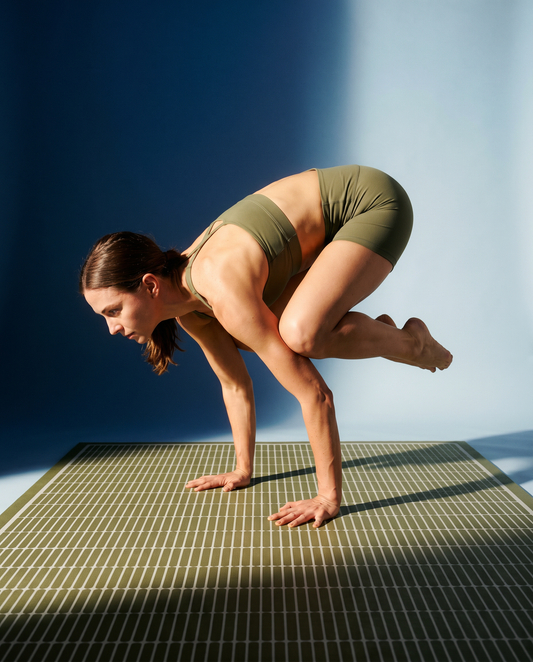
This is where a Swankymat belongs at the center of a yoga sanctuary. Its large, 6mm-cushioned surface is gentle on knees, wrists, and hips through a full practice, and it comes in calm, modern, neutral colorways like Sloane Dust that look intentional enough to leave out as part of the room. It's made with non-toxic materials and Greenguard Gold certified inks, which matters in a space meant to feel clean and restorative, and it's waterproof and wipe-clean, so it stays serene with almost no upkeep. Because it reads as a design piece rather than gym equipment, it doubles as a quiet anchor for the corner even when you're not practicing, much like a considered rug would. A sanctuary is built from a handful of intentional choices, and the surface you practice on is the one that holds the whole space together.