

Why You’re Not Working Out at Home (Even If You Want To)
It’s usually not about motivation
Most people who want to work out at home are not lacking motivation.
They have the intention. They have saved workouts, thought about schedules, and likely tried to start more than once. The gap is not between wanting to do it and knowing how. It is between intention and follow-through.
That gap tends to get explained as discipline, but that explanation does not hold up very well in real life. Most people are capable of consistency in other areas. What changes at home is the environment. Without realizing it, the setup makes it harder to begin.
Your space is working against you
At home, everything exists in the same place.
Work, rest, childcare, and movement all compete for the same space and the same time. There is no clear shift from one activity to another, and that lack of separation makes it easier for workouts to feel optional.
If the space is not already prepared for movement, starting requires effort. Even small steps like clearing a floor, rolling out a mat, or deciding what to do can be enough to delay beginning. Over time, those delays add up. This is why many people feel like they “just can’t get into a routine,” even when they are trying.
If you have experienced that, it is often less about the workout itself and more about how your space is set up to support it.
You’re asking yourself to switch modes
Working out at home requires a mental shift that often goes unnoticed.
You are asking yourself to move from one role to another without changing environments. From working to exercising. From parenting to focusing on yourself.
That shift is easy in a gym or class setting because the environment does it for you. At home, you have to create that shift on your own.
If your setup does not support that transition, it becomes easier to stay in whatever mode you are already in.
Small setup steps matter more than you think
It is easy to underestimate how much small setup steps affect behavior.
Rolling out a mat, adjusting your space, or deciding what equipment to use might only take a few minutes. But those minutes happen at the exact moment when you are deciding whether to start.
If starting feels even slightly inconvenient, it becomes easier to delay. And once something is delayed, it often does not happen at all.
This is one of the reasons simpler setups tend to lead to more consistent routines. Fewer steps mean fewer opportunities to hesitate.
The problem with most workout setups
Many home workout setups are designed around function, not real life.
They assume you will take time out of your day, prepare your space, complete a full workout, and then reset everything afterward. That model works well in theory, but it does not always hold up in a busy home.
In reality, movement often needs to fit into smaller windows. It needs to happen without a full setup or a clear beginning and end.
This is where many traditional setups fall short, particularly those built around smaller, temporary surfaces. If you have ever felt like your mat limits your movement or requires constant adjustment, you are not imagining it.
What actually makes it easier to follow through
When people do stay consistent with home workouts, it usually comes down to one thing.
Ease of starting.
Their space does not require preparation. Their setup is already there. Movement feels like an option that is always available, not something that has to be initiated.
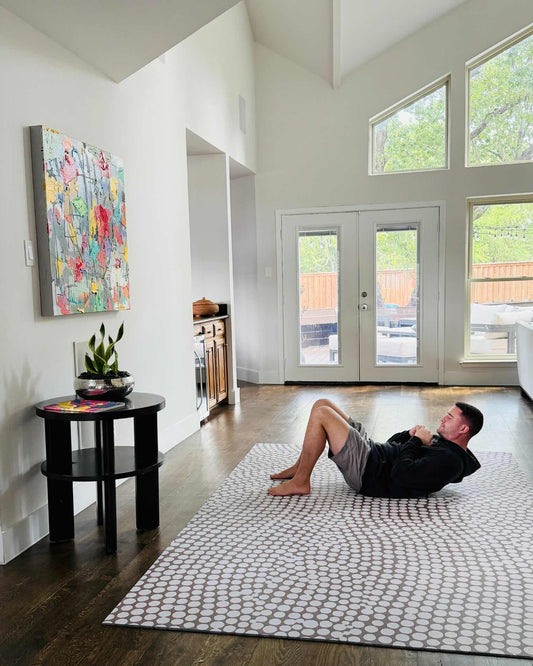
This is why integrated spaces tend to work better than setups that need to be assembled and taken down. A surface that remains in place changes how often it gets used.
It removes the step that most people underestimate.
It’s not about doing more
There is a tendency to think the solution is to try harder or do more.
More discipline, more structure, more time.
But in most cases, the shift comes from doing less. Fewer steps. Fewer decisions. Fewer barriers between intention and action.
When starting becomes easier, consistency follows.
A more realistic approach to home workouts
For most people, a sustainable routine is not built around ideal conditions.
That might mean shorter workouts. It might mean moving in the same space where everything else happens. It might mean letting go of the idea that a workout needs to look a certain way to count.
What matters more is that it happens consistently, and that usually comes down to how easy it is to begin.